


Dear Friends,
Last week I had lunch with a Chinese student named Yiran studying at Oxford who, after hearing a talk I gave on Jacques Maritain’s philosophy of education, joined me and others on a half-day Marian pilgrimage I organized in Oxford in December 2023. That pilgrimage was her first experience of Christian prayer. Moved by her experience, Yiran started going to Bible study and Christian worship at a St. Aldate’s Anglican Church in Oxford.
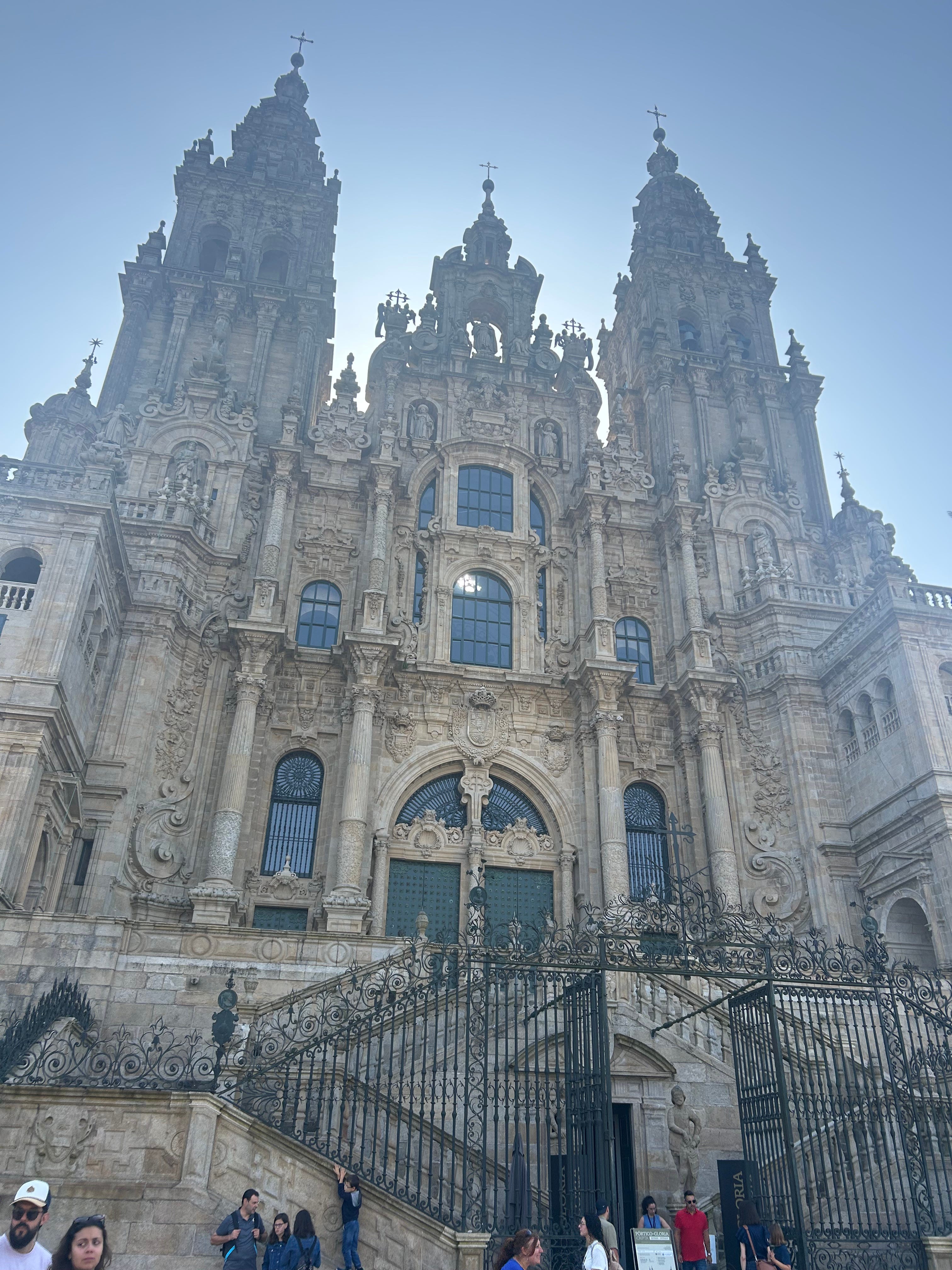
I pondered Yiran’s description of how that pilgrimage affected her during my trip a few days later to Santiago de Compostela, the famous pilgrimage site in northwest Spain. While I was in Santiago, my 19-year-old niece Cami was on pilgrimage in Fatima. Cami and I reunited after our pilgrimages to celebrate my cousin’s wedding in Galicia, where I was unexpectedly asked to simultaneously translate the homily from Spanish to English, prompting further reflections on the symbolism of marriage as mutual self-gift.
When I arrived in Santiago, I honestly had no idea what to expect. I was preoccupied not so much with spiritual matters but with family matters, greatly anticipating seeing my relatives at the wedding that took place about an hour south of Santiago. My camino (path) to Santiago took place not by foot but by plane. Whereas others walked and fasted for days to reach Santiago, I went in a Tesla taxi from the airport to my comfortable hotel bed. When I awoke, I ate a 7-course breakfast, and walked 400 yards from my hotel to the cathedral.
Having survived being hit by a car while walking across the street in Princeton in 2019, I am grateful I can walk at all. During my last pilgrimage, which was to Fatima 6 years ago, I was in horrible pain, whether sitting or standing. Surgery, medicine, physical therapy, and personal training to build strength all helped me to feel (nearly) pain free when I arrived at Santiago. Walking into the plaza, I was astounded at the jubilant crowds of young people around Cami’s age who had come in large groups from far away by foot. People older than me also had arrived by foot and eagerly took selfies in front of the magnificent facade and towers.
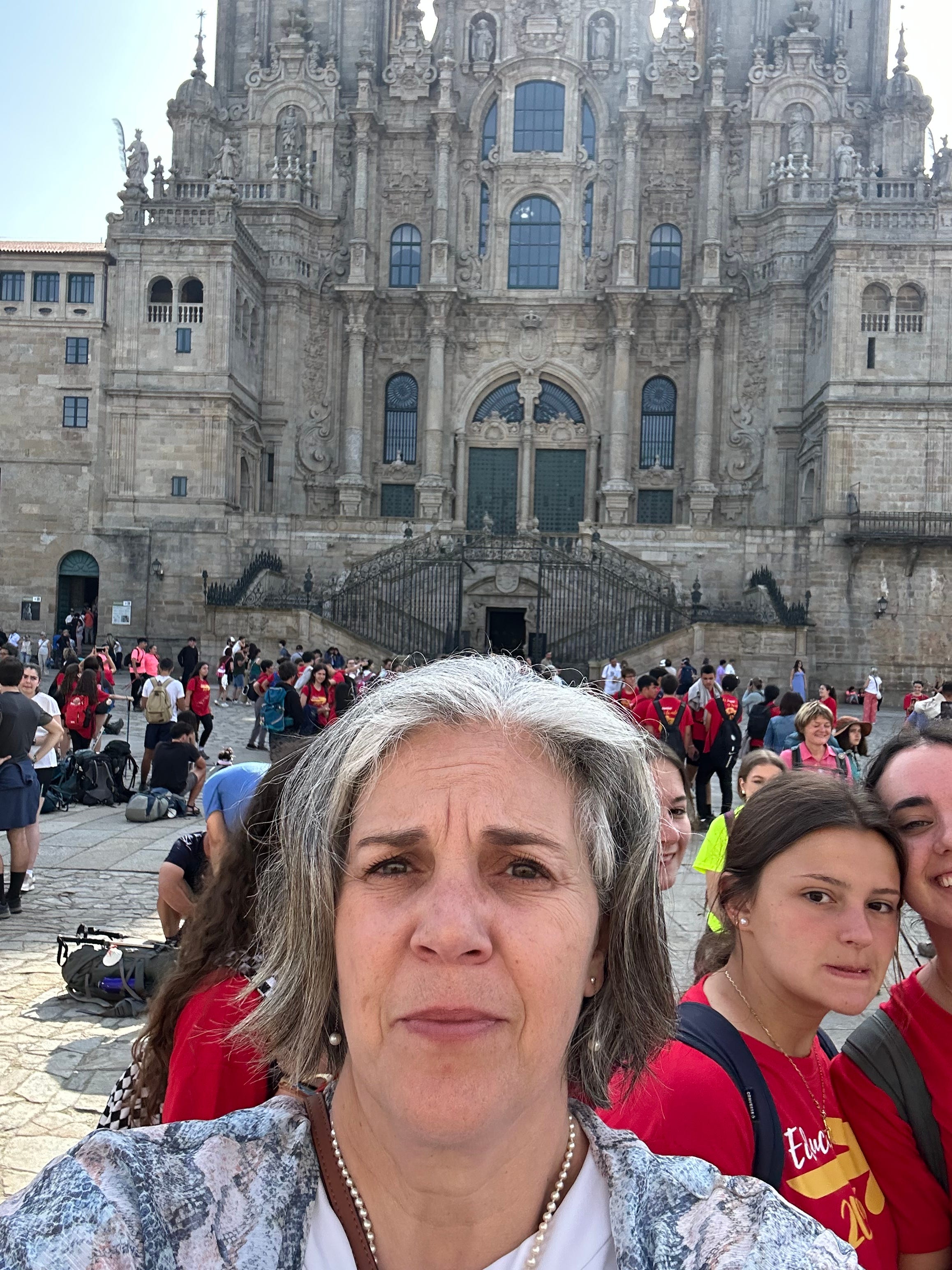
I entered the Cathedral through the now tightly restricted Portal of Glory. Struck by the grandeur of the Romanesque carvings, dating to the 12th century, I gazed up at them and was overwhelmed by the sense of my littleness. Christ in his glory faced me directly, as if asking me: do you wish to enter into this glory?
The prophets and saints surrounding Christ proclaimed to me what I had told Yiran: the glory of God is the human person fully alive. The carved animals—both real and mythical—symbolize that all of creation is from God, yet God’s glory is so magnificent we need mythical figures to remind us that we are called to a mystery that goes beyond our senses. Twenty-four angels, each carved holding a different musical instrument, filled the space with the silent signs of heavenly jubilee.
When I saw a sign proclaiming this great Cathedral as one of the 2025 Jubilee sites, where pilgrims are invited to receive a special grace of the remission of the punishment of sins, I lamented how unprepared I was for such a great gift. Surrounded by sweaty and sunburned pilgrims from around the world, I marveled that every seat and every aisle was jam-packed with people awaiting the worship of the Mass.
In my morning prayer, I had recited Psalm 202, “My days are gone like a shadow; I am withered like the grass. But thou, O Lord, shalt endure forever and they remembrance throughout all generations.” When, during the homily at Santiago, the presiding bishop said, “A pilgrimage is a metaphor for life,” I pondered how—feeble as I am physically and spiritually—I am nonetheless lifted up by a cloud of witnesses who have gone before me in faith.
Kneeling in the confessional moments after receiving communion (yes, the order was backwards, but once I was there, I was diving into whatever came to me in whatever order), I was reminded that no matter how hard I repent from my sins I can’t heal myself. To be a Christian is not to reach human perfection; to be a Christian is to accept to turn back to God every time we sin, knowing our Father loves us and is waiting for us.
In the homily, the bishop reminded us that we are rotting away like clothes being eaten by moths. Psalm 103, also a part of my morning prayer that day, tells us that we are but dust; here one day and not the next. “But the merciful goodness of the Lord endureth for ever and ever upon them that fear him and his righteousness upon his children’s children.” Entrust everything to God, everything, the priest told me during confession. Despite our sinfulness, God loves us personally and cares deeply about our worries, so much so that he wants to carry the burden.
Grateful for the sacrament of confession and the priests wisdom, I was surprised that he poked his head around the confessional to urge me to go see the botifumero—the incense burner that is the size of a small dormitory refrigerator—being swung on a pulley.
As I was singing the closing hymn, a Spanish woman complimented me on my beautiful voice and told me to keep on singing (thank you Max—my voice teacher). Quickly after Mass, I followed young pilgrims in pink t-shirts to the tomb of Saint James, then up to his statute where we were invited to give him an ‘abrazo’—a hug.
During my seven-course buffet breakfast (with no less than 3 espresso drinks) earlier that day, I had read philosopher Alisdair MacIntyre’s words that the death of Christianity in Europe and of Marxism as an ideology had left triumphant individualism reigning. He wrote that essay in the 1970s, more than a decade before he became Catholic. What would MacIntyre, who died in his 90s earlier in 2025, have seen in those pilgrims? Certainly triumph, but not one of individualism or rationalism, but the triumph of faith.
What I saw were people from every continent sharing their faith in living communal practices that ties people to not only those walking next to them today, but to a past that is also alive in its rituals and in its saints in heaven. To stare at a statue of Christ is not to worship the statue—it is to come as close as we can to meeting our savior eye-to-eye. With the light of Christ shining, I turn away from my selfishness, my pride, my clinging to autonomy, embrace everyone around me as a fellow pilgrim, and walk towards the heavenly jubilee.
A day later, being asked impromptu just before my cousin’s wedding to translate the homily from Spanish to English gave me a few clues about we gain when we die to pride, autonomy and selfishness
They key theme of the wedding homily was that, in marriage, you give yourself to another who gives himself to you and in doing so you will find happiness. Whereas in English we often embellish words by using adjectives, in Spanish, words and grammar are often already embellished.
“Entregarse uno al otro y serás bieanventurado” is shorter and more fun to say. Referring to the Beatitudes we heard at Mass, the priest repeated the word “bienaventurado” in Spanish, which we translate in English to blessed or just happy. But the root word “adventure” gets lost in that translation—the faith is a great adventure, a great invitation to a life fully lived. To say yes to the invitation of faith is renounce any desire to dominate an pledge our desire to unite.
The reflexive tense in Spanish emphasizes the mutuality of the self-gift of Christian marriage—a total, complete, giving (entregarse). The reflexive verb further indicates a repetition of that gift, which is a sign of abundant love, a love that approaches us continuously like a new adventure. Bienaventurado can be also said as “afortunado” in Spanish, which in English means fortunate. Perhaps, if we keep in mind the root word “fortune” we can begin to grasp the limitless joy that comes from renouncing autonomy and freely giving oneself to one’s spouse.
As the priest reminded the bride and groom, being married in the church means they are making their vows before God, asking God to walk with them on this pilgrimage of life together. The community that gathered for the wedding was invited by the priest to pledge their love and support to the bride and groom. “We are witnesses to your self-give of love,” he said. Having picked the longest day of the year—June 21—to marry, the priest reminded the couple to be light to each other when darkness comes. Pray together before bed. Forgive one another. Be meek.
I looked up at a statue of Mary holding an anchor in this 1,000-year-old church in a seafaring town in Galicia. The final hymn that refers to Mary as the star of the sea and a phoenix of beauty. We are heading to the glory I experienced in the Portal at Santiago, but we will endure many deaths to self, as well as many moments of jubilant return to God’s mercy. Mary reflects the light of Christ; she has journeyed before us in faith and anchors us to the community of faith.
Lighting candles for my prayer intentions at Fatima last week, my niece Cami texted me a picture that all the candles suddenly melted together and created one giant fire. “I think it was the Holy Spirit!” she texted. The fire that burned all those candles together is a dim yet powerful metaphor for our unity in love.
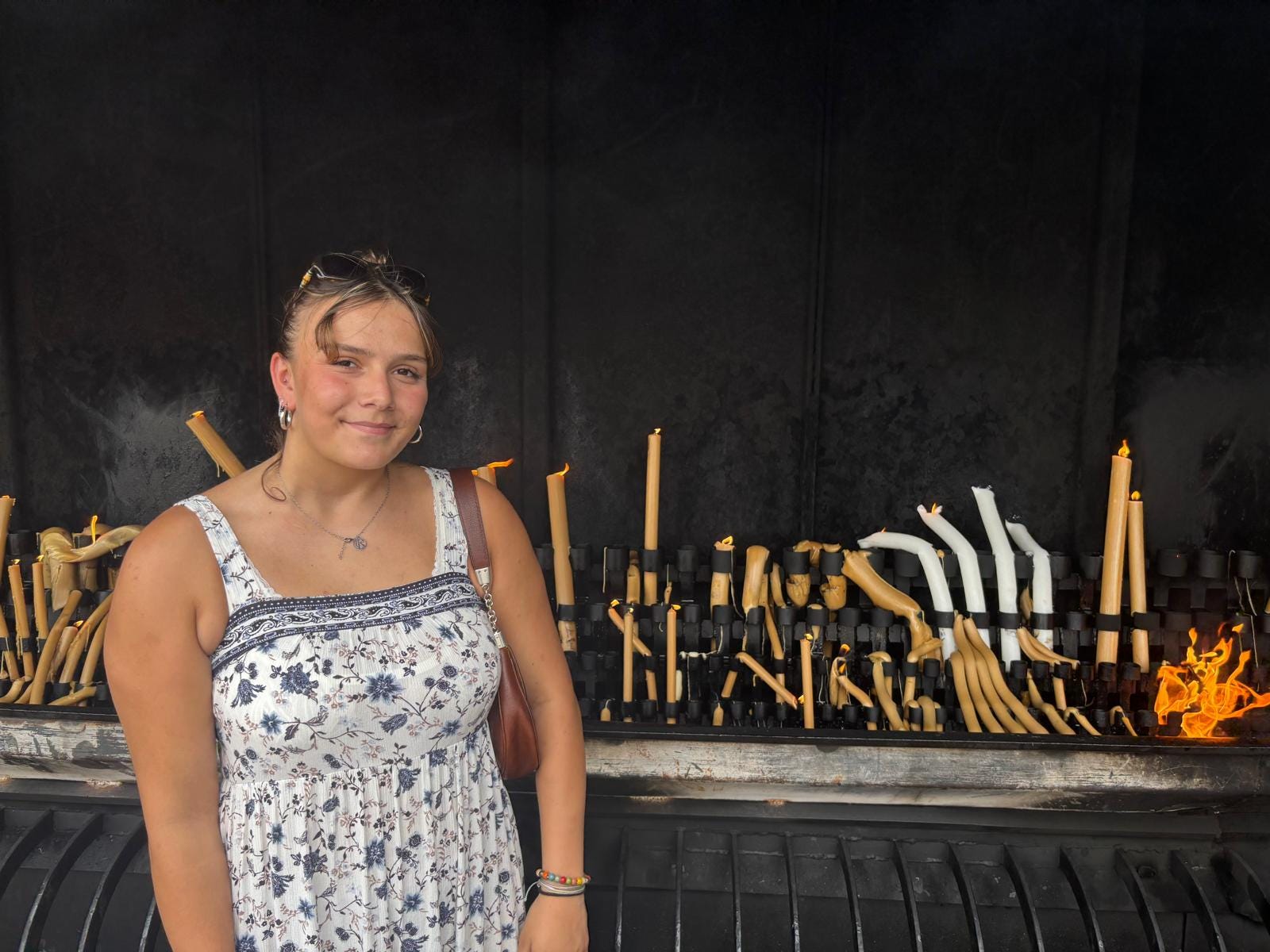
In just one week, the experiences of three pilgrimages—Oxford, Fatima, and Santiago—reminded me that I long to be “bienaventurado” every day—blessed by giving of myself to others and receiving God’s abundant spiritual and material gifts. I felt the fire of the Holy Spirit guiding each step, each word in my translation, knowing that my feeble efforts are met by glory beyond measure.
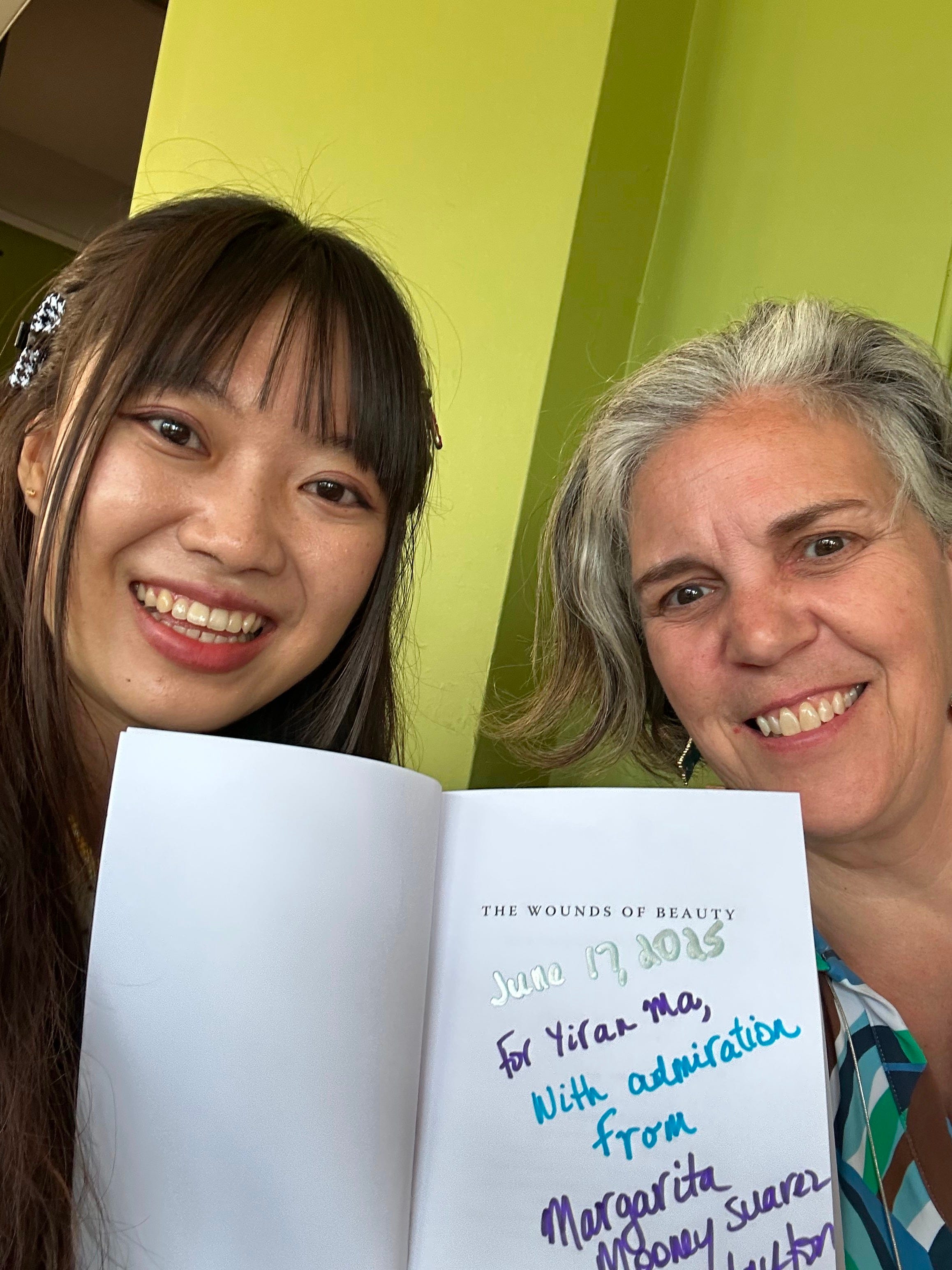
The three-day wedding feast that followed my brief pilgrimage to Santiago reminded me that Christ, too, rejoiced at a wedding feast. As I told Yiran, Christianity teaches that the glory of God is is magnified by human happiness. I gave her my book The Wounds of Beauty, and encouraged her to keep up her artistic practices and to find a community of Christians to pray with when she returns to China this summer.
Christ is reaching out to us with his invitation to the adventure of a life freely given. As I intuited as I stood gazing at the Portal of Glory, his capacity to give back is greater than our wildest imaginations.
How do you feel called to embrace life as an adventure? Where can you give of yourself more to community and open yourself to the light of Christ shining through that unity with others? Do you have any pilgrims’ notes you’d like to share with me or others?
Regards,
Margarita Mooney Clayton, Ph.D.
Executive Director, The Scala Foundation
PS: A week from today, on Tuesday, July 1, 2025, you can join me live or on Zoom for Scala’s one-day symposium on theology and the arts being hosted by Blackfriars Hall, Oxford University. Check out our website for information on how to join the livestream—or come on over to England!