


For my recently published book When Mary Calls: Surprising Encounters with the Mother of God, I shared insights from world-renowned Catholic composer Sir James MacMillan on how he sees Mary as a inspiration for creatives, as she was fully open to divine inspiration.
Today, June 2, 2026, MacMillan’s latest composition, entitled Angels Unawares premieres in London. Working through our senses, this oratorio Angels Unawares leads people into a space of contemplation where we can experience the mystery of our existence and respond to our personal callings with faith and service. I hope that this new oratorio, and MacMillan’s beautiful music about Mary we discuss in my book, invite broad audiences of seekers and people of faith alike to re-encounter traditional Christian themes of trust in God and compassion for the stranger.

MacMillan sees the music he writes as a chance to reach people who are searching to connect their spiritual longings to a religious tradition. As MacMillian explains in my book on Mary, the Christian view of creativity stands above what MacMillan calls the “transient fashions and banalities of the culture of today.” Christianity, he explains, must be incarnational: as Christ took flesh in Mary’s womb, along with Mary, we are called to be vessels of the grace of the Incarnation, infusing the divine spirit into matter.
“Catholicism has always meant a lot to me,” MacMillan said. “But in those early days I couldn’t see any way of allowing the religious dimension into the practice of my music, and, of course, those who flattered themselves that they were at the cutting edge of this particular art form would say that there was no place for something as reactionary and anachronistic as the Catholic faith in the modern artistic world.”
Abraham’s Hospitality to Angels
Angels Unawares challenges us all—whether seekers or regular religious practitioners—to ask ourselves what we make of Biblical stories of angels.
Imagine you’re a nomad in the desert, trying to protect your household in a harsh land. Three strangers are approaching your compound. What do they want? What do you do?
If you are Abraham of the Bible, because you are steadfastly obedient to God in his wisdom and mercy, you rush out to welcome them into your home. You offer them water, bread, milk, a freshly prepared calf, and a cool place to rest during their journey. And then these three unfamiliar figures deliver a message from God: that you and your wife Sarah, far advanced in years, are going to have a child.
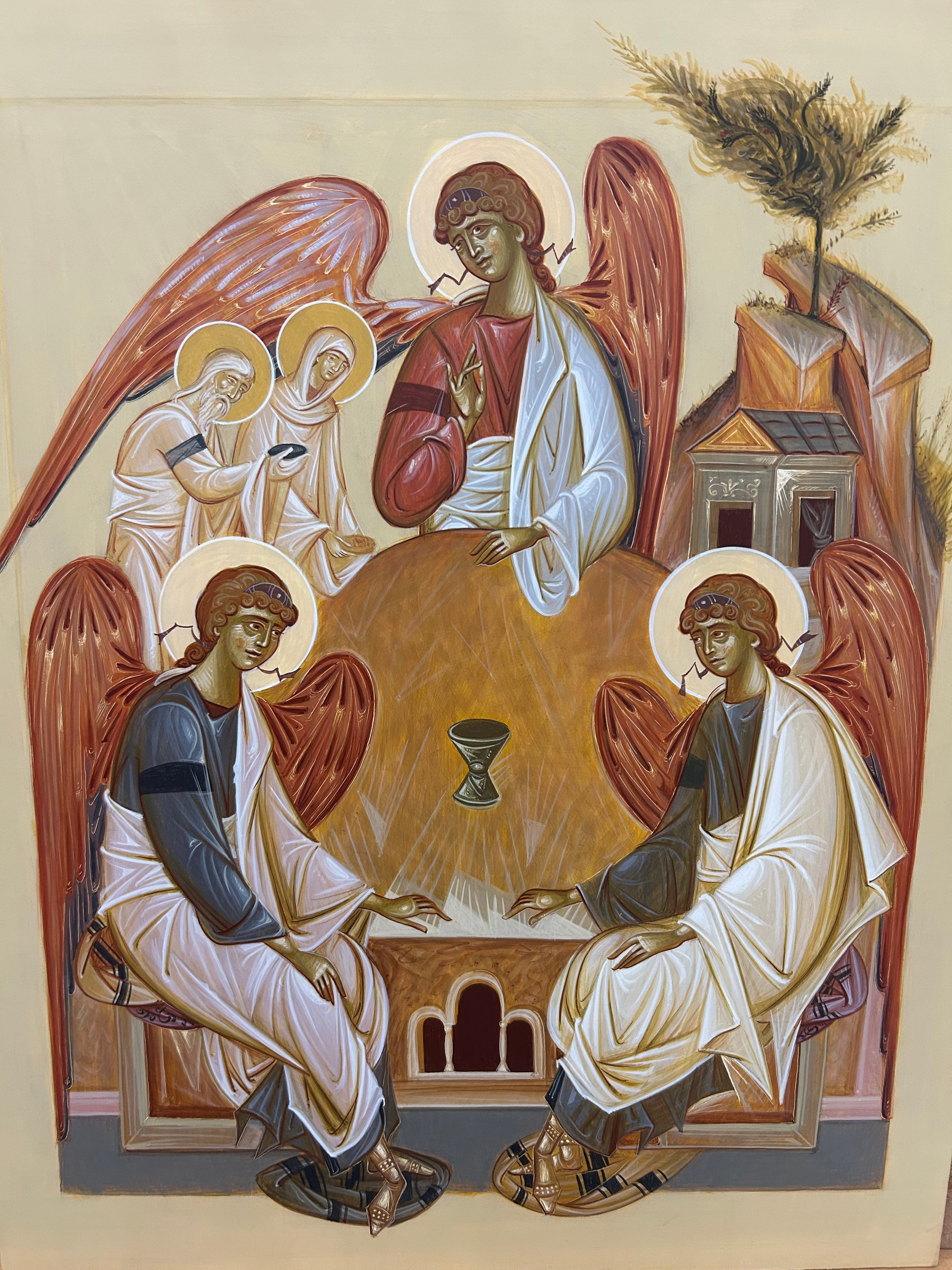
Commenting on this story from Genesis, St. Paul would write: “Be not forgetful to entertain strangers, for thereby some have entertained angels unawares” (Hebrews 13:2).
Named for this passage, Sir James MacMillan’s new oratorio Angels Unawares premiers today, June 2, 2026 in London. The composition sets to music twelve poems by the late Richard Willis that call our attention to surprising encounters with angels in the Bible. Abraham’s loving attention to strangers encapsulates MacMillan’s aim with this piece: to enrapture our attention through music so we may be transformed by the presence of the divine within us and respond with greater love for others.
“At its core it is an encouragement to show kindness to strangers as a spiritual discipline, an appeal to treat all individuals with dignity and compassion, recognising that every encounter with another person could carry a deeper (even supernatural) significance than it appears on the surface. There is an added layer of mystery to the verse, implying that angels might be present in everyday life, unnoticed,” MacMillan told me.
“There are many people in today’s world who are fascinated and beguiled by the idea of angels,” he said. “And they run like a significant theme throughout the Judeo-Christian legacy.”
As MacMillan said, “the curiosity for many seekers is that these unexpected, mysterious things that happen to have a deeper implication, both supernatural and ethical. We are being called to enter into a deeper sense of compassion in our daily lives, and that compassion comes from a deeper spiritual significance. The Christian message at the heart of these angelic encounters reminds us of the desire for God, of the numinous, for us to be more kind, more forgiving in our lives.”
MacMillan’s composition is an invitation to recover that loving attention to God’s active dwelling in each of us that inspired Abraham’s hospitality to strangers. Christianity is not primarily an ethical code of conduct, but a way of life that opens our hardened hearts to receive God’s loving gifts and respond in kind.
Here is a recording of this piece from its world premiere, which had its world premiere at the Sistene Chapel in the Vatican earlier in 2026.
Christian Mysticism and Ethical Action
As Jacques Maritain, a twentieth-century Catholic philosopher, wrote in his magnum opus The Degrees of Knowledge, mystical contemplation of God is the basis of truly ethical action. Because of human sinfulness, only through an encounter with God do our actions become motivated by love. Christian mysticism and Christian ethics were never meant to be separated.
In the modern world, however, too often people want to harness the power of the mysterious or the spiritual for their own ends. This is a mistake. Mystical encounters are not meant to center ourselves or draw us out of the world; rather, they refresh our bodies and souls to encounter others in deeper ways.
After the opening line from St. Paul, the oratorio proceeds chronologically through Scripture. Not all encounters with the spiritual world are benevolent: the first story we hear about is Eve’s temptation by an evil spirit that led to humanity’s expulsion from the Garden of Eden. This is followed by Abraham’s hospitality.
Next, Old Testament visions of Angels—from Jacob’s ladder to Elijah and Ezekiel—stoke our imagination, guiding us to wonder about the still small voices that suggest we too might hear from God. When, like Elijah, have we felt a still small voice moving us to greater love and hope?
Mary’s Encounter with an Angel Challenged Her
The New Testament passages open with Mary’s encounter with the angel Gabriel, which startled her and challenged her. Mary was troubled by the angel’s words, “you will conceive in your womb and bear a son, and you will name him Jesus.” (Luke 1:31) This was not a plan she had for herself, and she didn’t understand it. But she consented, saying, “Here am I, the servant of the Lord; let it be with me according to your word.” (Luke 1:38)
Despite her great call, Mary didn’t draw attention to herself. Rather she ran to be at the side of her cousin Elizabeth, who had conceived a child in her old age (John the Baptist).
None of us will be asked to do what Mary was. But any of us, if we listen, may be challenged by a message from God.
Wrestling with Powers of Darkness
Christ was not free of temptation, wrestling with powers of darkness in the wilderness. New Testament figures Nathanael and Mary of Magdala are recalled for their visions of angels, who led them to recognize Christ as their savior. Peter was so dramatically freed from prison by angels that the guard was tempted to kill himself but instead embraced Christian baptism.
Angels Unawares ends with John’s visions in Revelation remind us that the spiritual battle, though won eternally by Christ, continues in this world. Yet, we are meant to be comforted, indeed protected, by the woman in Revelation 12 who crushes the head of the serpent—an allegorical image of Mary.
A Musical and Catholic Revival Coming from Scotland?
Born into a secularizing, impoverished area of Scotland in 1963, how is it that a composer, and a man of deep Catholic faith like MacMillan is now bringing to the UK a resounding invitation to hear music of angels?
Today, many young people in the UK are raised with no exposure to the beauty of Christianity. In my studies in sociology, when the topics of art and beauty were raised, we were expected to scorn the religious inspirations behind works of art and music as if those motivations or any high ideals cover up the so-called “true” desires for power, domination, or subversion. Has the tide of secularism now shifted in the United Kingdom and in the arts world?
In remarks given in Italy in 2002, Pope Benedict XVI stated that “the radiance of the beauty we contemplate opens the soul to the mystery of God.” A true encounter with beauty, Benedict XVI adds, must lead to a readiness for sacrifice, not desire for power; to self-giving, not possession.
Perhaps that’s why MacMillan’s music, and increasingly the Catholic faith behind his work, continue to spark curiosity among large audiences in his native UK and among the millions who have listened to his work on YouTube or Spotify. MacMillan has grown more confident in asserting that he believes his work is divinely inspired, which led one journalist to declare that idea was so avant-garde that it is countercultural. He embraced the term, now describing his music as part of “a brave radical countercultural vision…to attempt to resynchronize the world around us.”

As I’ve noted in my new book, When Mary Calls: Unexpected Encounters with the Mother of God, traditional Christian practices like pilgrimages and veneration of images of saints and Mary—practices once proscribed by Henry VIII’s 1538 injunction, given by Thomas Cromwell—have seen a resurgence of interest from Catholics, Orthodox, Anglicans, and other Protestants in the United Kingdom.
In his comments on my book, Jonathan Pageau, an icon carver, public speaker, YouTuber, editor of the Orthodox Arts Journal, and host of The Symbolic World blog and podcast wrote that:
“As the shadow of secularism passes over us, an increasing multitude of people wish to experience a deep connection with God and experience His presence in creation. When Mary Calls will help us remember Mary as both the Mother of God and our own mother. Margarita Mooney Clayton shows us the many ways Mary guides us to the embodiment of her Son.”
I sincerely hope that many people who hear MacMillan’s work Angels Unawares or his rousing music about Mary, or his music for the liturgy, will be filled with the most real yet most elusive, mysterious sense of being seen by angels, embraced by a loving God, and will stand up, walk out, pick up the Gospels, go to a beautiful Sunday liturgy, and dedicate their lives to compassionate service.