


Dear Friends,
On November 22, 2025, David and I were honored to host Cardinal Robert Sarah in our home for dinner with about 12 guests. Earlier that afternoon, he reminded a packed auditorium at Princeton University of the meaning of the Incarnation: the divine has entered human history in the person of Jesus Christ. Because of the mediation of Christ, we are capable of a great intimacy with God. But, too often, we fail to appreciate this mystery, much less participate in it with reverence at the sacred liturgy.
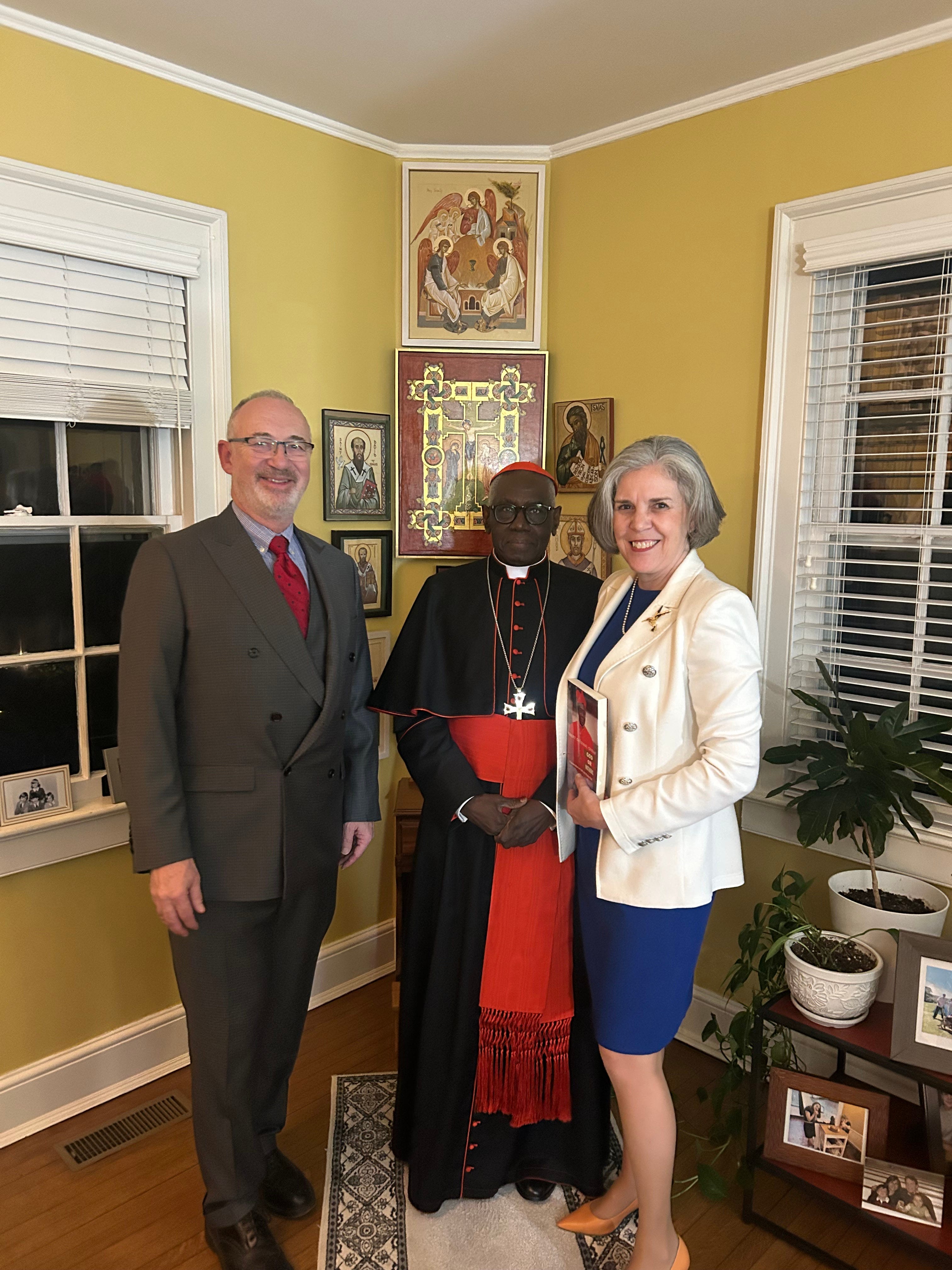
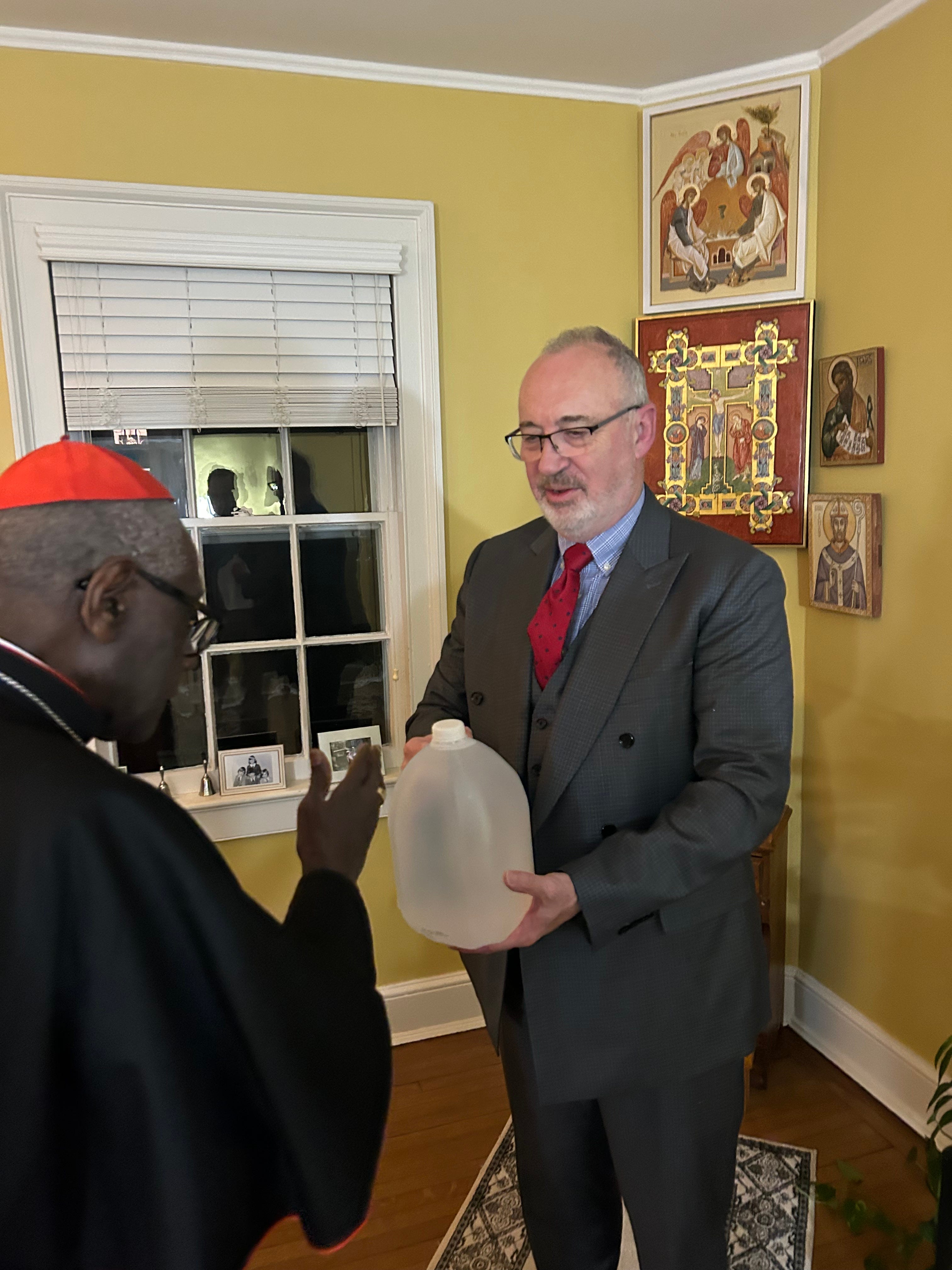
Here I am, holding his book “God or Nothing” and standing in front of our home icon corner. As David explains to all our guests, the images of the Trinity, the Crucifixion, the Face of Christ, Mary, the Mother of God, the saints and prophets are the sacred center of our home. But, notice the plans. And the family photos. The faith shines out into the world, pulling all of God’s creation back towards its destiny. Cardinal Sarah kindly blessed gallon of water so that we have holy water for anyone who enters our home.
Sitting at our dinner table, the Cardinal spoke about the Gospel with the zeal of a new convert and the wisdom of a monk whose zeal has been fine-tuned in silence, patience and humility. How many people’s lives are too distracted to be aware of just how incredible something like the Incarnation really is? I, for one, was feeling convicted all week as the Martha, the ever-busy anxious and serious hostess, inside me tried to drown out Mary, the joyful, simple hostess.
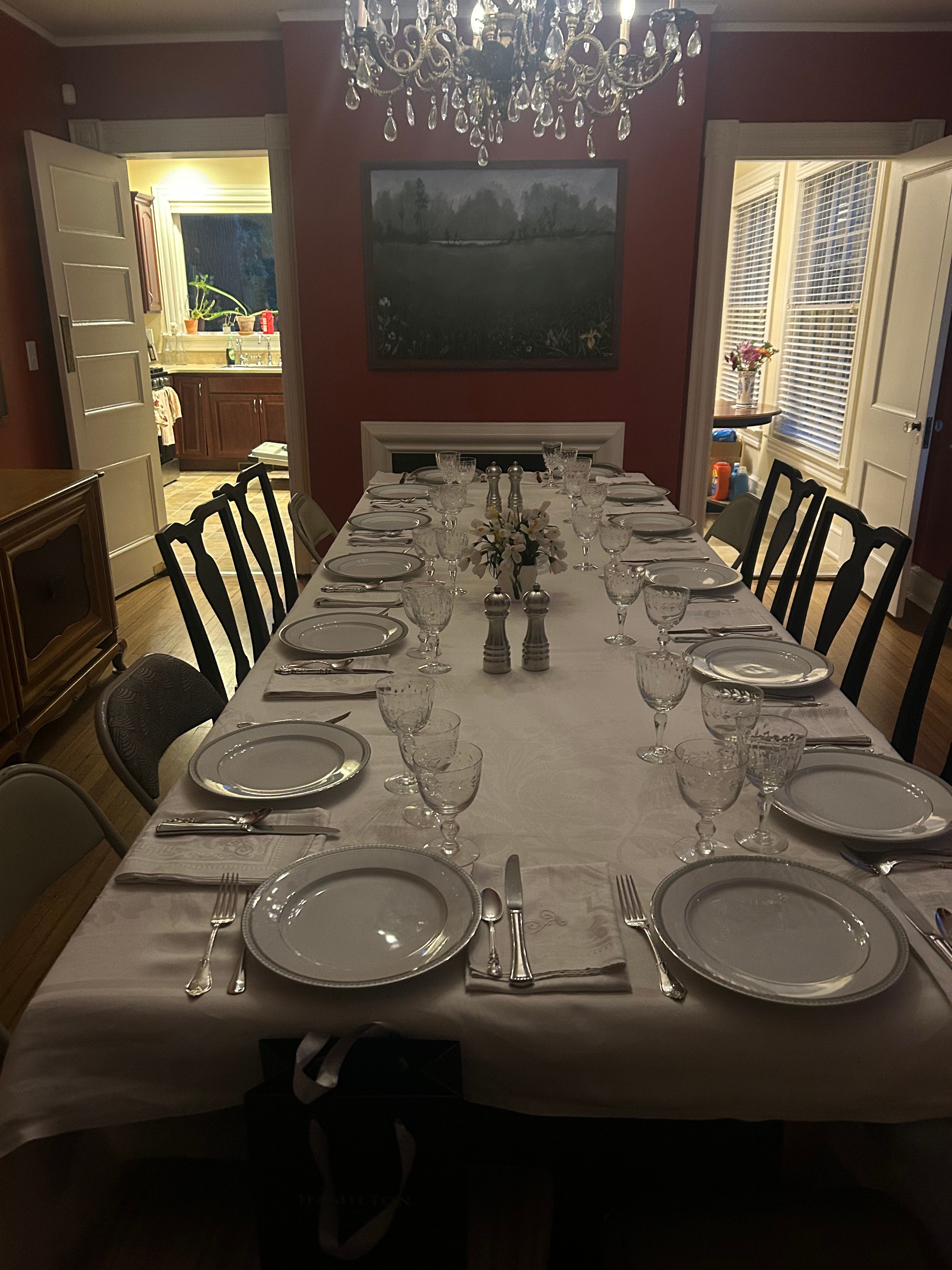
I mean, it’s not everyday I set the table like this. But when I do, I’m grateful to have my great-grandmother’s linens and my grandmother’s silverware. The china we received as a wedding gift dresses up the table. Is this extravagance? I think it’s elegance, a beauty that is simple and inviting, special but not ostentatious.
Once I sat down at the table, all the hard work of many hands flowed together to make a perfectly relaxed and enjoyable evening. Was it flawless? No. For one thing, my first pot of coffee was so weak it went down the drain. A guest took over, making it much stronger.
The next day, the choir rehearsal for the Eucharistic liturgy celebrated by Cardinal Sarah started in chaos. A choir from a prior event ion Princeton’s grand chapel (which really looks like a 14th century English Cathedral) was busily taking down microphones, music stands, and video cords while two choirs joined to sing together for the first time: the choir of the Aquinas Institute at Princeton and St. John’s Catholic Church in Allentown, NJ. Peter Carter is the music director of both, and he worked with the Cardinal on his latest book on sacred music, even persuading him to do a book launch right here in Princeton. I was so overwhelmed by the new voices that it took me half the rehearsal to find my place with so many beautiful new voices.
My voice teacher Max commented the following day that the liturgy we celebrated with the Cardinal felt like many hands making light work. “Every week we practice for an event like that, each person in the liturgy doing a particular part, over and over again,” he said. Not to downplay the average Sunday Eucharistic celebration, but to note that every once in a while, Sunday Mass does feel like what the Cardinal said it is: a foretaste of heaven. Processions with altar boys and clergy, chanted prayers by priests, beautiful songs by a choir, and participants kneeling, bowing and receiving the waters of grace.
But can we see the grace that comes to us from the cross? The Eucharistic liturgy is not a festival like a giant concert at Wembley Stadium. In his homily, Cardinal Sarah reflected on the meaning of Christ the King through the Gospel of the two criminals crucified alongside Jesus. While Christ hung on the cross, one criminal mocked him, prodding him to save himself if he was truly God. The other criminal acknowledged that his sins led his condemnation, but he had faith in Jesus’s power to redeem him, saying,
“Jesus, remember me when you come in your kingly power.”And he said to him, “Truly, I say to you, today you will be with me in Paradise.” (Luke 23: 42)
Do we believe that Christ’s kingdom is available to us always ? Even in our dark moments when injustice strikes us? Even when we suffer due to our own sins?
Cardinal Sarah exhorted us not to a life of worldly achievement but a life of peace. As someone who finds her meaning in work well done, I know the Cardinal was not suggesting that laziness is a virtue and elegance is wasteful. The dinner at my home and the Eucharistic liturgy were beautiful works made by many human hands. But without the peace of the Kingdom of Christ, our dinner tables and Eucharistic tables can turn into a parody of themselves. Maybe we don’t see the dignity of our family members we eat with every day; maybe we don’t see our own dignity elevated by Christ when we approach the Eucharistic table in humility. Maybe we want to be in control of our destiny, not to ask for grace to light the way and gloss over our many imperfections.
At the conclusion of the Eucharistic celebration, the choir processed down the center aisle of Princeton’s chapel chanting that Christ has won the victory for us, his kingdom is here, now. Reaching the side chapel where we all knelt in Eucharistic adoration, an interior silence took hold of me, and I pondered the nearly 800 people kneeling with me at that moment.
I’m the first one to admit that worldly activity distracts me from spiritual realities. The cross is a scandal, a stumbling block, to me. But at the weekly liturgy, I can practice the humility I need through my bodily actions, like kneeling. I can receive grace, and ask for peace, trusting that, as little as I am, as unworthy as I am of my own merit, I’m meant to shine with joy and peace, not wallow in self-pity.
The Incarnation happened more than 2,000 years ago, and, as the Cardinal said, recognizing that fact changes how we see history. It changes how see others. It changes how se see ourselves.
I’m grateful to Peter Carter of The Catholic Sacred Music Project, The Aquinas Institute and St. John’s in Allentown, NJ for making many hands come together for this unforgettable visit.
The Advent season is a time of many meals with loved ones and many special liturgies. May Mary, not Martha, rule in our homes. May we approach the Eucharist good criminal, with humility about ourselves and confidence in the power of the divine to triumph over the darkness.
Thank you Cardinal Sarah for reminding me that Jesus spent 30 years in ordinary family life, working, and sharing meals. Thank you for reminding me that his public ministry ended in the crucifixion. Thank you for reminding me that his resurrected body is alive today in our homes and in our divine liturgy, if only we could allow our vision to be transformed to see it.
Sincerely,

Margarita Mooney Clayton
Executive Director, The Scala Foundation
Thank you for sharing,God bless you all