


“Why do people think conservatives are boring, and what can we do about it?” Such was (roughly) a question I got from a Yale undergraduate who hosted a panel discussion I was on at the David Network in January 2026. I was dismayed and surprised that my answer—to co-create beauty with God will attract others to goodness and truth—was deemed ‘boring’ indeed by a co-panelist who is a public figure known as a conservative fighting liberal social norms.
When my co-panelist grabbed the microphone, he said artists should be “transgressive”, by which he explained breaking with norms of how artistic forms existed in the past.
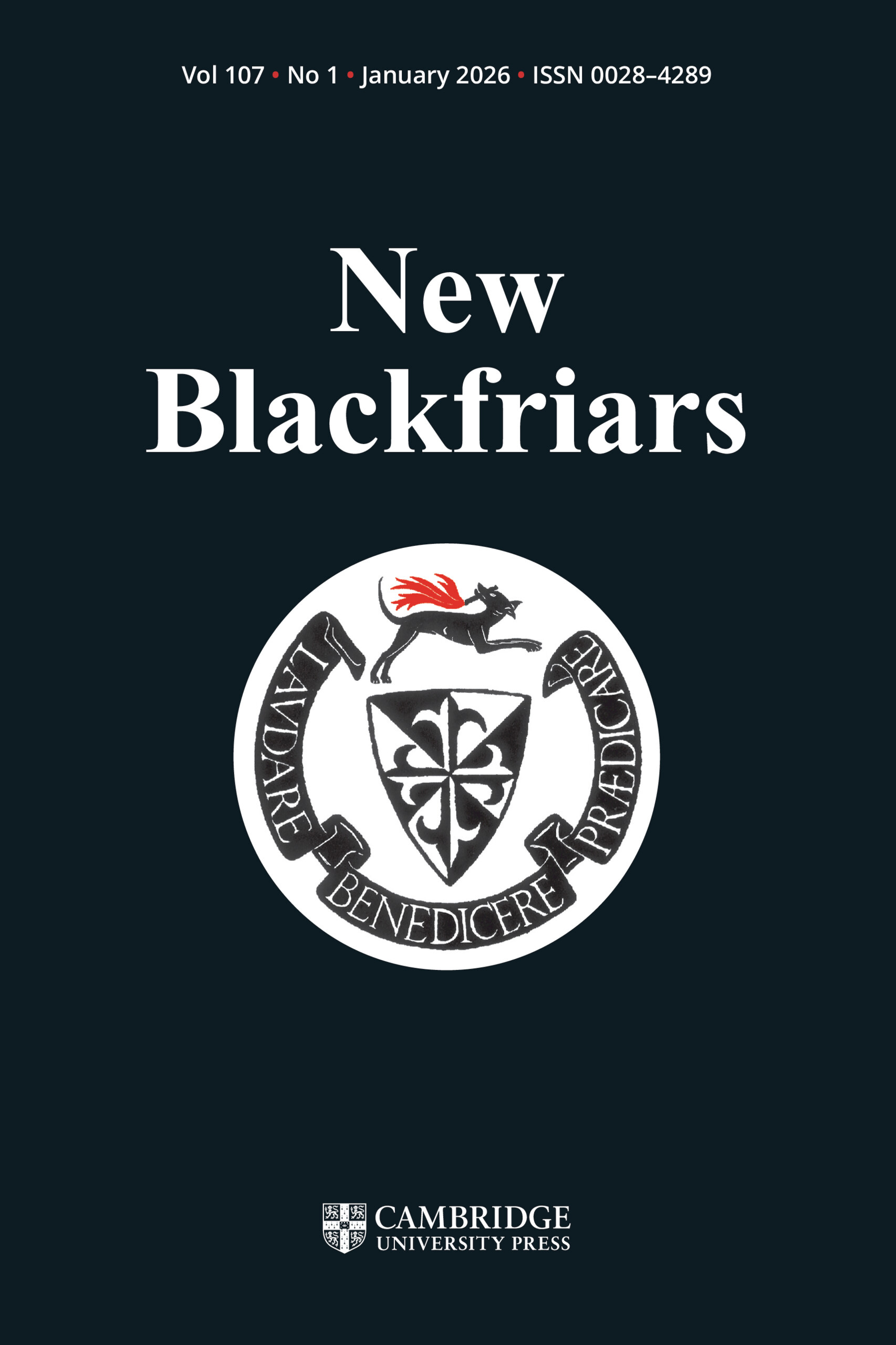
Before I summarize that panel, let me share that I’m writing to you today because a longer form of my answer to this debate was just published by the scholarly journal New Blackfriars. This article is open-access, which means you do not have a subscription to read the article online or download it as a PDF. Read the full article in New Blackfriars here, to learn why the Catholic convert, philosopher and friend of many artists, Jacques Maritain, feared that both surrealism and romanticism had corrupted the Christian view of the artist as divinely inspired.
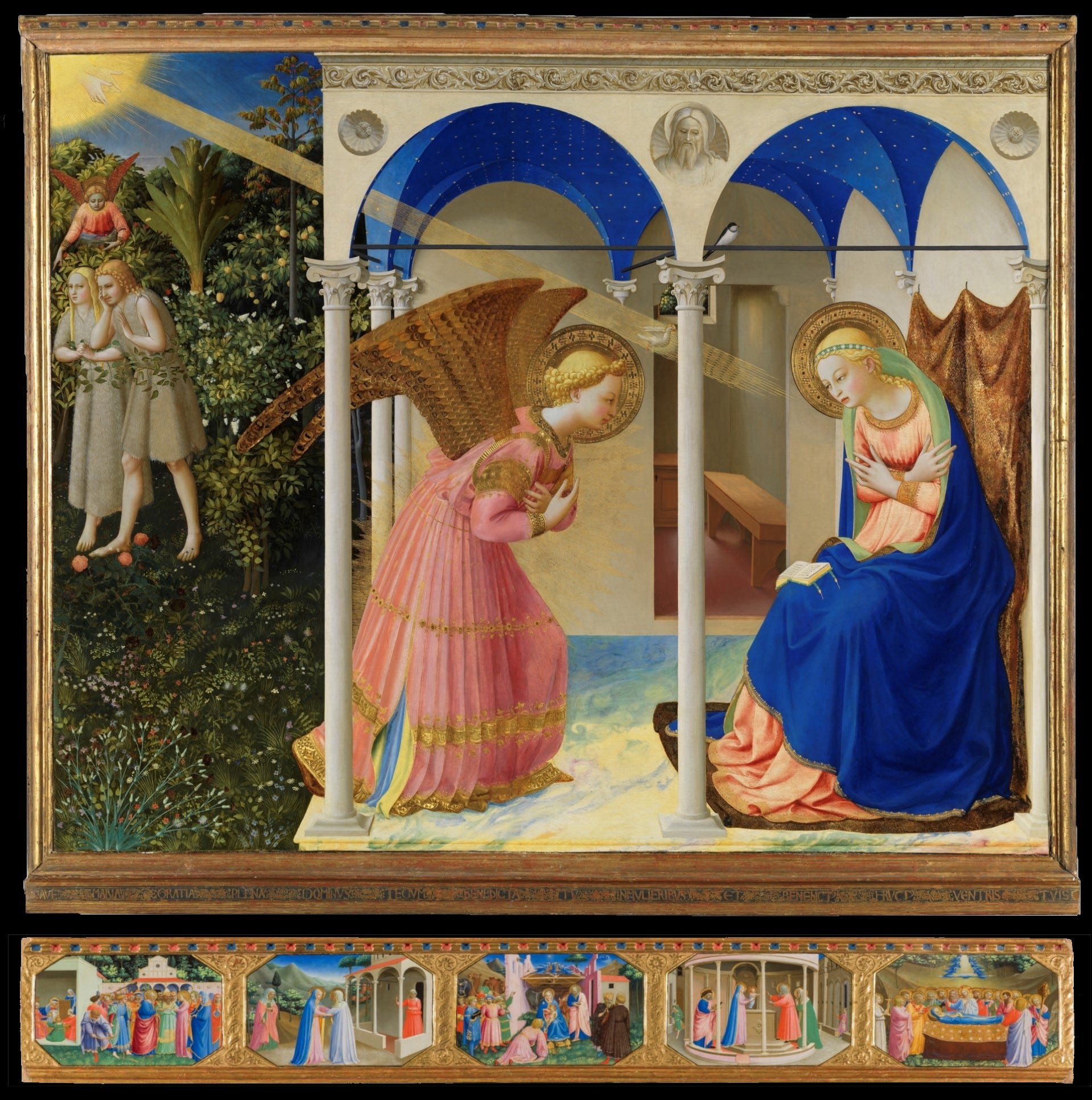
I’m publishing this reflection on my article today, March 25th, which is the feast of the Annunciation. When I spoke on the vocation of an artist to artists gathered for the Writing the Light iconography workshop in August 2025, I directed them to a painting of the Annunciation. Mary’s willing cooperation with God’s plans for her body to become the temple of the Holy Spirit is a icon of what an artist is called to do; human cooperation with grace opens artists to divine inspiration. I contrasted that image with the contemporary idea of an artist who is a Promethean figure who steals fire from the gods but then turns his back on the gods in defiance of them. At the end of that talk, I was greeted with hugs and sighs of relief from people who had fled “transgressive” artists’ circles and who sought to use their talents to make beautiful art.
Now, back to Washington, DC, and the David Network, where I eagerly shared Scala’s mission with the room packed with young people, hoping to inspire them with the great calling to be creative in a way that learns from tradition and makes all new things shine the brilliance of the past with the best of today. Boredom, I believe, is fundamentally not knowing how to direct your passions. We can be very, very busy but existentially bored. Knowing I was speaking to future lawyers, doctors, engineers, and CEOs, I challenged them, “Do you have one hour a week to dedicate to learning and practicing something beautiful like music, art, woodwork or gardening?” I know that won’t pay most people’s bills, but it will make us happier, and it will allow us to build a beautiful culture that attracts others to our way of living in harmony with nature and God.
But how many people who call themselves artists and read my co-panelist’s writings on conservatism would self-identify as “transgressive”? The artists I work with through Scala rarely, if ever, self-identify as transgressive. My music teacher told me he would never intentionally be transgressive, as that seems to call attention to his personality, not his music. But this young Catholic convert said, if his music is different, noticeable, and even challenging that’s okay—yet he still needs to know if it is beautiful. This young man left the (dare I say boring?) world of unbelieving music halls to make music that is meaningful and sacred. Perhaps, if he transgresses in his musical practice, it’s a step towards being corrected. Or maybe, just maybe, with a few more attempts, he will pass out of the (perhaps necessary?) adolescent transgressive stage and just be a master of his craft and melt into the shadows as others journey towards God.
The world-famous artists I know such as Jonathan Pageau, Sir James MacMillan and Aidan Hart are neither boring nor transgressive. Anna Bond is a designer and board member of Scala. She co-founded Rifle Paper Co. with her husband Nathan, who is a talented musician and businessman. All of those artists make products admired by millions and bought eagerly in the free market. No one needs to teach anyone why their products are beautiful, it is self-evidently so—the great consensus is that we all want their beautiful products in our homes and churches.
When my panel concluded at the David Network, one after another young person came up to me beaming. “I’m a pianist.” “I’m an actor.” “I paint.” None of them told me they were “transgressive”. They told me they loved the message that all humans are called to co-create beauty with God, and that their love of beauty can renew culture.
If I sound like my husband David in these words, I can’t lie: he has influenced me on this topic. Shamefully, I admit that I once had the same stereotypes of artists as my co-panelist: that artists are transgressive. Perhaps that’s the ethos I imbibed as an undergraduate at Yale from plenty of clove cigarette-smoking, black clad, sad, rebellious artists of all kinds who wanted attention and approval.
My mistaken belief that artists are transgressive was major reason I canceled my first date with David. I was SURE that a self-described artist whose only credentials were math and physics degrees from Oxford University would be awfully boring, snooty, and transgressive all wrapped up in one. Thankfully, he was kind and considerate enough to re-schedule that date when, well, I got bored and wanted to take the risk to meet him.
How wrong, how dreadfully wrong, I was about David. I agreed to a second date with David because I thought I enjoyed learning from him about beauty and art. David drew me back into my own desires to co-create with God, back to my love of music.
Back to the student’s question: why do young conservatives fear being labeled as “boring”? What can be done about it? Perhaps people who proclaim that traditions matter, that social norms around sex aren’t inherently oppressive, and that hope exists in God’s providence fear being marginalized in college dining halls. But if those same conservatives invited others to a beautiful concert, to a long hike, to take an art class from a master, or to sing together, I don’t think they’d be automatically called boring.
I’ve met plenty of college students who confess to me that they are looking for someone to save their young soul from yet another transgressive “bender” of drinking, or who know their happiness doesn’t lie in bed hooking up with a stranger. Too much entertainment is boring us to death, as Neal Postman famously described. Too few conservatives dedicate their talents to making beautiful things that draw others away from the abyss of despair and towards truth, goodness and beauty.
The article I just published is my attempt to ground my views of the vocation of an artist in the scholarly work of Jacques Maritain. In popular parlance, I wrote my article in New Blackfriars to say that I do not think artists are called to be transgressive, if by that we mean in popular parlance that to be a good artist is to “free oneself from tradition” or “reject norms” or “probe the deepest abyss so we can be dark and sad” or “make myself the center of attention while I persuade you that ugliness is as awesome as a sunset.”
My Thesis
I hope I’ve persuaded you to take a few minutes to read my thesis, and if you feel so called, to read the whole paper. I know not everyone agrees with me, and I also believe that, some people incorrectly interpret Maritain’s writings on art and creativity, under-valuing his clearly Thomistic views of humans as co-creating beauty with God.
Here’s my thesis:
“The thesis of this article is that the understanding of the vocation of an artist in the writings of Jacques Maritain emerges as to develop habitus (practical virtues of the intellect) in order to direct their inspirations in order to make beautiful things that convey the spiritual heritage of the nation and the civilization and inspire others to contemplate God. This vocation to be an associate of God in creating beautiful works is a powerful reminder of the close relationship between all personal vocations and the common good.
I also write:
“In order to build a civilization of love, not one of endless absurdities, the vocation of the artist for Maritain must encompass not only communicating their own creative intuitions but also forming the receptive intuition in the hearer or the seer…Maritain concludes Creative Intuition in Art and Poetry by calling on artists to embrace their creative intuition and make objects that assist others in properly ordering their loves.”
I end my paper what is at stake in this debate. We live in a troubled world, and are looking for beauty to lead them to the truth and a good life, not ugliness or mere emotional delight masquerading as an escape from reality. As I wrote in my article:
If the societal threats the Maritains faced, Nazism and communism, no longer threaten civilization as they once did, new forms of Gnosticism that deny the full meaning of the Incarnation – the fusion of the divine and the human – reappear in philosophical, artistic, and political movements and even in theology. As Jacques Maritain well knew and warned, the vocation of the artist understood as egocentric self-expression threatens to become a dark mysticism which misdirects our collective spirit away from a unity of truth, beauty, and goodness and towards nothing but power and domination of others.
Artists create objects that we delight in when we bring those objects into the rooms of our interior castle for contemplation, a contemplation that guides our quest for personal holiness and directs our efforts for the common good of the nation and civilization. The arts are a powerful manner in which God’s presence among us is experienced as a strangeness, like a wound that pierces our hearts and opens us to an intimate friendship with our creator and sustainer.”
I hope this publication is useful to those teaching about the arts in the modern world. Too few articles, in my view, link abstract ideas about art to the human vocation to co-create with God, a vocation which certainly applies to artists.
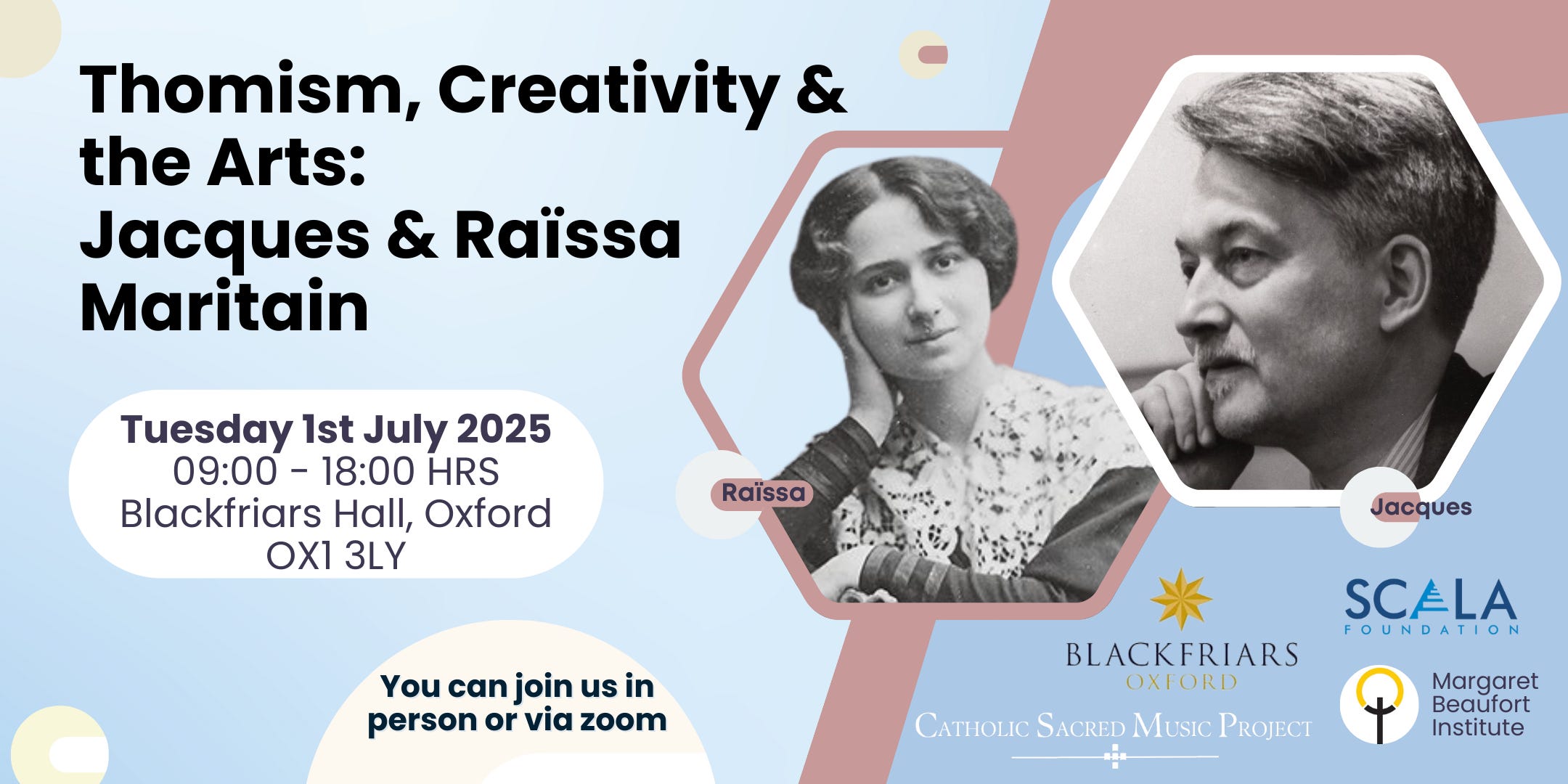
I encourage you to not only read my piece in New Blackfriars on the vocation of an artist, but to check out all the published papers from the incredible conference that the Scala Foundation co-hosted with Blackfriars Hall and the Margaret Beaufort Institute in July 2025. I don’t recall the words “transgressive” nor “conservative” nor “progressive” every coming up in our wide-ranging discussion of theology and the arts. I’m delighted to share with you our life-giving conversations which should be intelligible to all whose eyes, ears and hearts long for beauty.
Scala was pleased to partner with the Catholic Sacred Music Project for the musical components of this event, which included choral mid-day prayer and a beautiful choral mass. Below is a recording of a choir singing Sir James MacMillan’s motet “Benedicimus tibi” at Blackfriars Hall, during Mass where Sir James was present.
So many lovely thoughts here. My own spirit has found rest and peace in the beautiful so often, but my goal as an artist often feels too lofty; to be a conduit for His presence. I appreciate your (and Maritain's) affirmation to embrace the creative intuitive, and to allow the call and response that occurs during the process. Thank you for sharing. I look forward to reading your New Blackfriars piece.
“Perhaps that’s the ethos I imbibed as an undergraduate at Yale from plenty of clove cigarette-smoking, black clad, sad, rebellious artists of all kinds who wanted attention and approval.”
- there’s of course an attention/approval seeking equivalent (zipped, tucked and buttoned) trope among conservatives, whose preoccupation with Christian *optics* has frequently—often infamously— suppressed and even replaced the living gospel.
The thing that’s genuinely boring is engaging the left/right dichotomy as a soul compass mechanism as though it has that kind of legitimacy, sneering & jeering & othering those that diverge too significantly from one’s own internal landscape, and defaulting to assumptions like “tradition is always best” (the right) or “change is always best” (the left) — innovative Christian creators (not that there aren’t plenty of fine artists on both ‘sides’ — know when to step away from this truly exhausted and exhausting binary. Beauty, we surely agree, is transcendent.