


Yesterday, I traveled to the offices of The Spectator-UK for a “Holy Smokes” podcast interview with their religion writer, Damian Thompson, about my book When Mary Calls: Surprising Encounters with the Mother of God. [Note: The podcast was released here just days after I published this essay.]
Damian was eager to interview me, as my book shows that devotion to Mary is spreading among Protestants in England. One thing he mentioned was that England’s most important shrine to Mary, Our Lady of Walsingham, which was destroyed by Henry VIII in 1583 as part of the much larger suppression of Catholic practices in England during the English Reformation, was later restored by Protestants—the Anglicans.
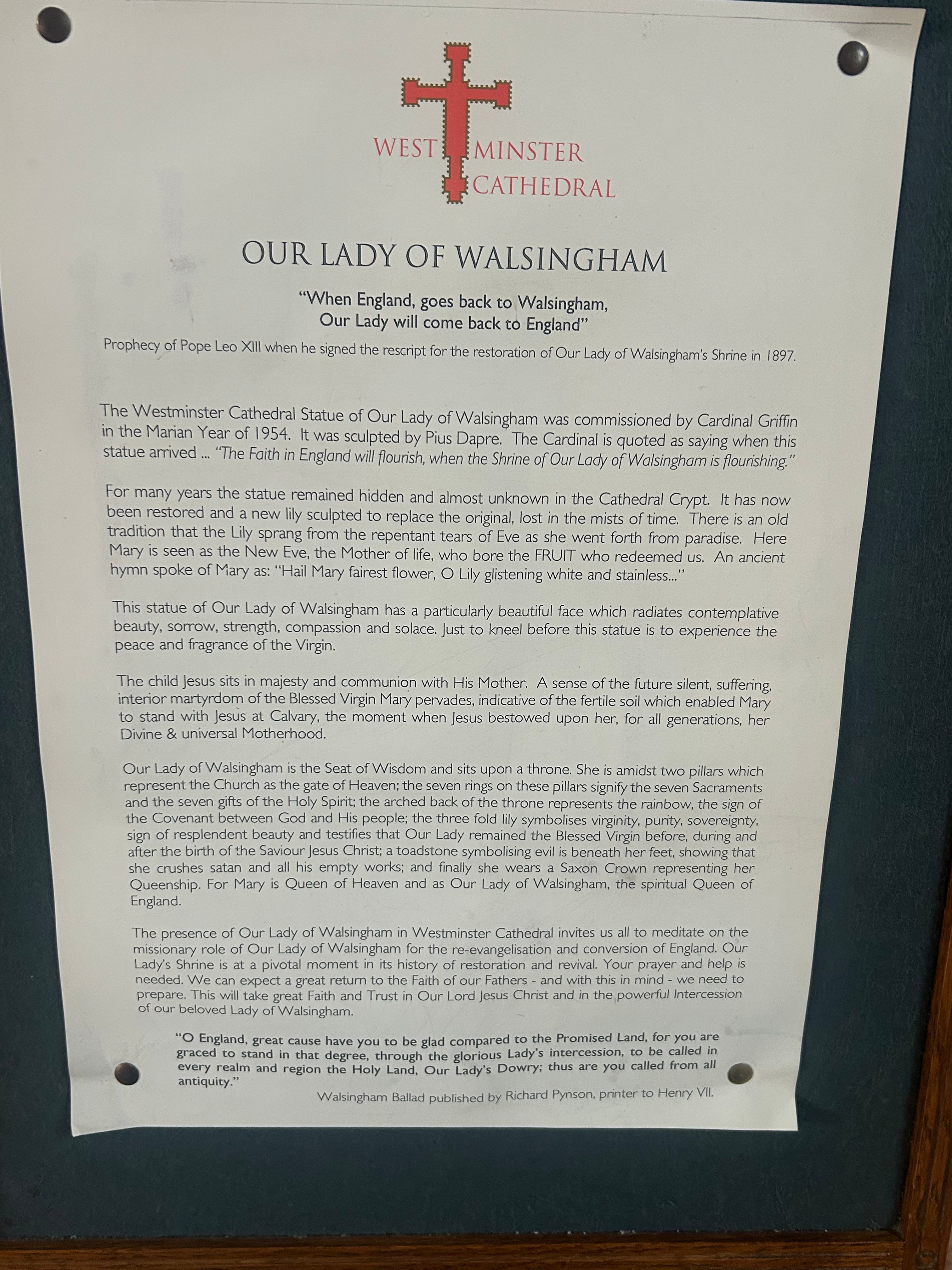
Catholics helped restore the shrine as well, which is noted in this sign I had seen just hours earlier when I visited Westminster Cathedral, the Roman Catholic Cathedral of London. (It bears a similar name to Westminster Abbey, which is Anglican).
The sign in Westminster Cathedral reads:
“When England goes back to Walsingham,
Our Lady will come back to England.” — Prophecy of Pope Leo XIII when he signed the rescript for the restoration of Our Lady of Walsingham’s Shrine in 1897.
Is this prophecy coming true?
I certainly see a return to Catholicism in England, and to devotion to Mary among Protestants and Catholics there.
For example, before 12:30 Mass at Westminster Cathedral in London yesterday, I noticed young men holding rosaries as they waited to have their confession heard by a priest. Who would have thought even five years ago so many young men would be lining up for confession in England?
During Mass, people of all ages and backgrounds stood, sat, knelt and prayed together. We then knelt together for Eucharistic adoration, followed by an organ concert.
After all that, I slowly walked around, looking at all the mosaics and paintings of Christ, Mary and the saints in the many side chapels. One elderly woman caught my attention. In each side chapel, she touched the statues and prayed softly but audibly.
The rebirth of faith in England includes the surprising return of once-proscribed practices that so many people at Westminster Cathedral were doing: praying the rosary, kissing statues, and lighting candles. Our Lady’s restoration to her shrine in England is indeed a sign of a much larger renaissance of faith.
Damian and I also discussed the surprising trend of young Protestants praying the rosary. The rosary is a Catholic devotion to Mary, which consists of long meditation on Scripture in which, either individually or in groups, people say one Our Father, ten Hail Marys, and the Glory Be.
When Damian asked me to explain why practices like the rosary are returning—not just among Catholics but also among Protestants—I confessed that I was surprised when I first heard about it. But reflected that it might be connected to the fact that Christian religious rituals and practices are not empty; they are ways we use our bodies to live out the mysteries we proclaim.
Christians don’t find God apart from the material world or sensory experiences—we are called to transform it through faith. What we do with our bodies, how we engage with the material world, is filled with symbolic meaning; symbolic meanings help us appreciate the mysteries of faith.
Yesterday after Mass, my heart filled with prayer intentions, people I had promised to pray for. So I lit five candles. Then I followed the elderly lady from the statue of Our Lady of Walsingham to a statue of the Pieta, that is, Mary holding Christ’s crucified body.
The elderly woman devoutly placed her hand on Christ’s wounded hand. She said a prayer.
Next, I approached the statue. One by one, I kissed the five wounds of Christ—both hands, both feet, and his pierced side. I gazed at his face and his mother Mary’s face.
My worries and anxious petitions melted into a joyous hope. There’s no glory without the cross. Our bodies may not evade illness or death, but we have hope in our rebirth. That’s why I don’t equate the emotional life with the spiritual life. When our emotions go up and down, we can cling to rituals, ask for greater faith, trusting that what we do with our hands, feet, eyes, and breath can be purified so we can enjoy a clearer vision of God at work in all things.
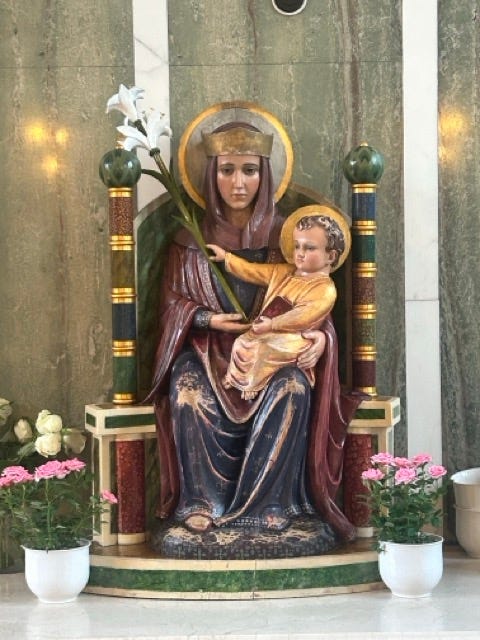
Back by the statue of Mary, I paused for a long time reading this explanation of the sculpture of Our Lady of Walsingham.
The Westminster Cathedral Statue of Our Lady of Walsingham was commissioned by Cardinal Griffin in the Marian Year of 1954. It was sculpted by Pius Dapre. The Cardinal is quoted as saying when this statue arrived … “The Faith in England will flourish, when the Shrine of Our Lady of Walsingham is flourishing.”
Is the faith in England flourishing? Perhaps not as it once was. But there is an urgency, a heartfelt need for the faith in England, and as journalist Mary Harrington noted in her review of my book, her own need for faith included a hunger for Mary as a spiritual mother.
Just as statues of Mary are coming out of hiding, more people like composer and conductor Sir James MacMillan, whom I talked with Damian about yesterday, are speaking publicly about the faith. All of these things led my husband David to write his reflections as an artist about why devotion to Mary is crucial to preserving the faith. This piece, a follow-up to David’s earlier piece about Mary Harrington’s review of my book, focused on the first seven ecumenical councils and addressed (among other things), the identity of Christ, the Trinity, the question of images in worship, and Mary.

Now is a moment when people are open to learning about the meanings of art that depicts Mary. The symbolism of the statue at Westminster Cathedral, among other things, is meant to help us recall that Mary is called the New Eve:
For many years the statue remained hidden and almost unknown in the Cathedral Crypt. It has now been restored and a new lily sculpted to replace the original, lost in the mists of time. There is an old tradition that the Lily sprang from the repentant tears of Eve as she went forth from paradise. Here Mary is seen as the New Eve, the Mother of Life, who bore the FRUIT who redeemed us. An ancient hymn spoke of Mary as: “Hail Mary fairest flower, O Lily glistening white and stainless…”
As Pope Benedict XVI wrote, Mary is the good soil of faith. To look at her face is to pause, and to let God work in our hearts. So explains the sign:
This statue of Our Lady of Walsingham has a particularly beautiful face which radiates contemplative beauty, sorrow, strength, compassion and solace. Just to kneel before this statue is to experience the peace and fragrance of the Virgin.
The child Jesus sits in majesty and communion with His Mother. A sense of the future silent, suffering, interior martyrdom of the Blessed Virgin Mary pervades, indicative of the fertile soil which enabled Mary to stand with Jesus at Calvary, the moment when Jesus bestowed upon her, for all generations, her Divine & universal Motherhood.
The statue is a mini-Catechesis, a poetic meditation on our redemption. So continues the explanatory sign:
Our Lady of Walsingham is the Seat of Wisdom and sits upon a throne. She is amidst two pillars which represent the Church as the gate of Heaven; the seven rings on these pillars signify the seven Sacraments and the seven gifts of the Holy Spirit; the arched back of the throne represents the rainbow, the sign of the Covenant between God and His people; the three fold lily symbolises virginity, purity, sovereignty, sign of resplendent beauty and testifies that Our Lady remained the Blessed Virgin before, during and after the birth of the Saviour Jesus Christ; a toadstone symbolising evil is beneath her feet, showing that she crushes satan and all his empty works; and finally she wears a Saxon Crown representing her Queenship. For Mary is Queen of Heaven and as Our Lady of Walsingham, the spiritual Queen of England.
Following my interview at the Spectator’s office, I strolled past Buckingham Palace and caught a bus back to Oxford, literally arriving at kickoff time for the World Cup semifinal match between England and Argentina. Perhaps these days the World Cup is one place where we see nations unite across political, cultural and class divides.
At pubs all around England, voices, bodies and hearts were united in celebration when England scored the first goal. But an hour later, England fans accepted a 2-1 defeat.
Analogies between sport and religion are often overplayed. But the rituals of sports watching simply remind us that rituals bind us together. Religious rituals in particular bind together the living and the dead into a grand narrative.
Mary’s presence on English soil is made real by the blood of martyrs, by the pilgrims to Walsingham of all faith backgrounds, and by my little candles, prayers and kisses. Mary’s motherhood symbolizes a love that endures beyond any political cycle, sports season, or, in fact, beyond this life.

As the sign next to the statue concludes:
The presence of Our Lady of Walsingham in Westminster Cathedral invites us all to meditate on the missionary role of Our Lady of Walsingham for the re-evangelisation and conversion of England. Our Lady’s Shrine is at a pivotal moment in its history of restoration and revival. Your prayer and help is needed. We can expect a great return to the Faith of our Fathers - and with this in mind - we need to prepare. This will take great Faith and Trust in Our Lord Jesus Christ and in the powerful Intercession of our beloved Lady of Walsingham.
“O England, great cause have you to be glad compared to the Promised Land, for you are graced to stand in that degree, through the glorious Lady’s intercession, to be called in every realm and region the Holy Land, Our Lady’s Dowry; thus are you called from all antiquity.” --Walsingham Ballad published by Richard Pynson, printer to Henry VII.
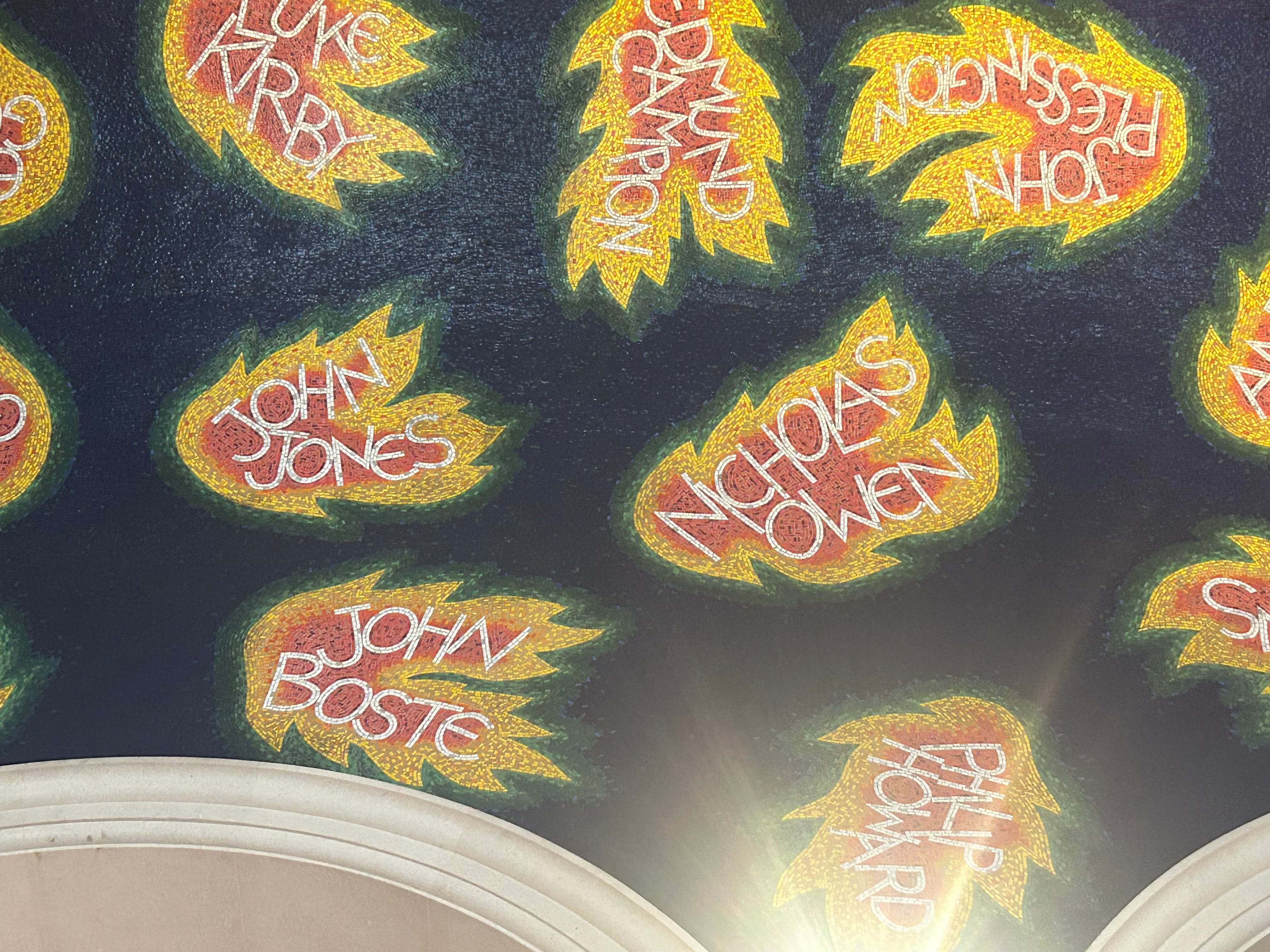
The Catholic martyrs named in Our Lady’s Chapel at Westminster Cathedral believed in God so much that they walked their own Calvary, looking to Our Lady for comfort. I looked up above at the names of some of the martyrs commemorated in this side chapel. I don’t recognize John Jones, Nicholas Owen or most of the other names.
But Saint Edmund Campion was a Jesuit who publicly attempted to persuade Anglicans, including students at his alma mater of Oxford University, to return to the Roman Catholic Church. He was convicted of treason, imprisoned, and killed in 1581 by being hanged, drawn, and quartered. Today’s home for Jesuits in Oxford, Campion Hall, is named for him, and the undergraduate Catholic ministry the Jesuits run in Oxford is overflowing with new young Catholics.
Margaret Barker, a Methodist minister, theologian and Old Testament scholar in England, has written in her excellent book The Mother of the Lord.
“The Christian message was not only that the Messiah had come; it was also about the restoration of the Lady. Just as her son was proclaimed as the Lord, Mary was proclaimed as the Lady…She [Mary] was the formative influence on the style of the great churches built by Justinian; her ancient titles, even those not recorded in canonical texts, were known and used both in liturgy and in theological debate; and much, much later, the lost Lady of the first temple was to appear in ikons, in her ancient setting and with her traditional symbols.” (Margaret Barker, Mother of the Lord)
Damian asked me about doctrinal differences between Catholics and Protestants. I explained to him the appendix of my book summarizes Protestant, Catholic and Orthodox writings on Mary. There is more common ground among Christians than many imagine on doctrinal issues. So, let us not make Mary a barrier to Christian faith, but a source of unity, allowing her love to penetrate our hearts and showing her true devotion.
Interesting that a Pope Leo made the prophecy and now we have a Pope Leo again.
I saw a man walk past my house with a rosary just last week.
First time ever.
Also had my glow-in-the-dark-plastic rosary fly out of the dryer at me the same day.
Took the hint and started praying it every evening before bed : )
The spirit of the Reformation is still strong in the UK, don’t worry, Mariolatry won’t ever dominate again