


Dear Friends,
As we begin Lent, I wanted to share the words of my meditation to a group of students from Princeton Theological Seminary (PTS) about the importance of slowing down our minds to recall we are always in God’s presence. On Monday, February 9th, 2026, at the PTS chapel, we gathered for prayer, and I offered these words, borrowed from a book of meditations I use often, Divine Intimacy.
“Grant me, O Lord, to understand the joy and the responsibility You have given me, in communicating Your life to me: that I may die to self and live solely for Thee.”
We listened to the story of when Jesus Visits Martha and Mary, from Luke 10: 38-42.
38 Now as they went on their way, he entered a village; and a woman named Martha received him into her house. 39 And she had a sister called Mary, who sat at the Lord’s feet and listened to his teaching. 40 But Martha was distracted with much serving; and she went to him and said, “Lord, do you not care that my sister has left me to serve alone? Tell her then to help me.” 41 But the Lord answered her, “Martha, Martha, you are anxious and troubled about many things; 42 one thing is needful. Mary has chosen the good portion, which shall not be taken away from her.”
Here is my reflection on this Gospel passage that I shared.
When listening to these words from scripture, they can seem a bit troubling. But what appears to be the obvious message may not be the message we’re intended to receive. I’m not sure it’s so obvious that this scripture passage is meant simply to somehow help us weigh up how hard one person is working or another, or how we’re supposed to speak to others about what we think they should be doing.
When a scripture passage troubles us or seems unusual, it begs the question: what do we need to think is true about Jesus in this passage in order to make sense of what’s going on?
One of the things that this passage is inviting us to remember and, in fact, to contemplate, is that Jesus was fully human and also fully divine. We know from the Gospels that Jesus had friendships. It’s kind of incredible that God would have close friendships! Jesus’s words are not a harsh rebuke of his friend Martha. His words are more of an invitation to remember that although Christ is intimate to us and close to us, He also divine.
If Christ is divine, and He enters our midst and comes so close to us. But we’re distracted by many things—distracted to the point of calling out other people for not doing what they should be doing. Christ is saying, “What is the one thing necessary?”
We should ponder the words of a contemplative mystic, St. Teresa of Avila, whose works on mysticism and the contemplative life have inspired many saints and many writers and artists. But St. Teresa of Avila was also an incredibly active woman. She entered the Carmelite convent in Spain in 1535, during a time of crisis. Convents were falling under corruption; their life of and their rule of life wasn’t being respected. St. Teresa went on to reform existing convents, and she founded no less than seventeen religious communities. Seventeen communities!
What can take away from this passage that will help us as we begin to enter the time of Lent? If we remember that Christ is divine but has lowered himself to come as intimate to us as entering our own living rooms, one of the things we can take away from this passage is simply the realization that we often don’t see the gifts of Christ right in front of us. We are rightly worried about affairs in our home, affairs in the world, affairs being a student. But the presence of Christ amidst us, this gift, is also a calling to recognize our dignity of being sharers in the divine nature.
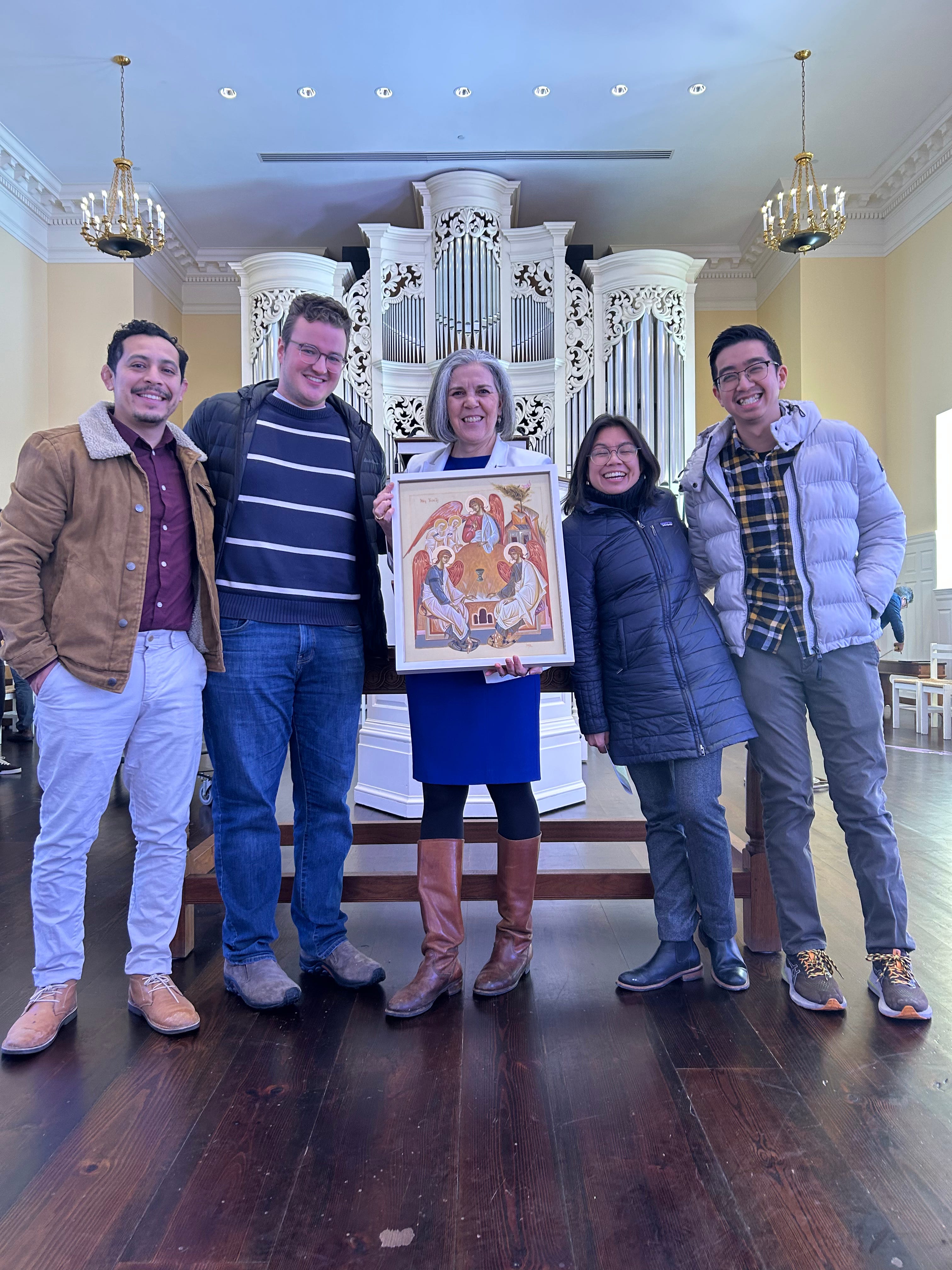
I brought a painting with me today, this painting over here by an artist in Havana named Jose Cortes, to remind us of the three-in-one nature of the Trinity. This image is inspired by the hospitality of Abraham. You see Sarah and Abraham who welcomed three strangers into their midst. A famous iconographer named Andre Rublev painted an icon upon which this one is based; this depiction is often thought of as portraying the Trinity, three persons in one.
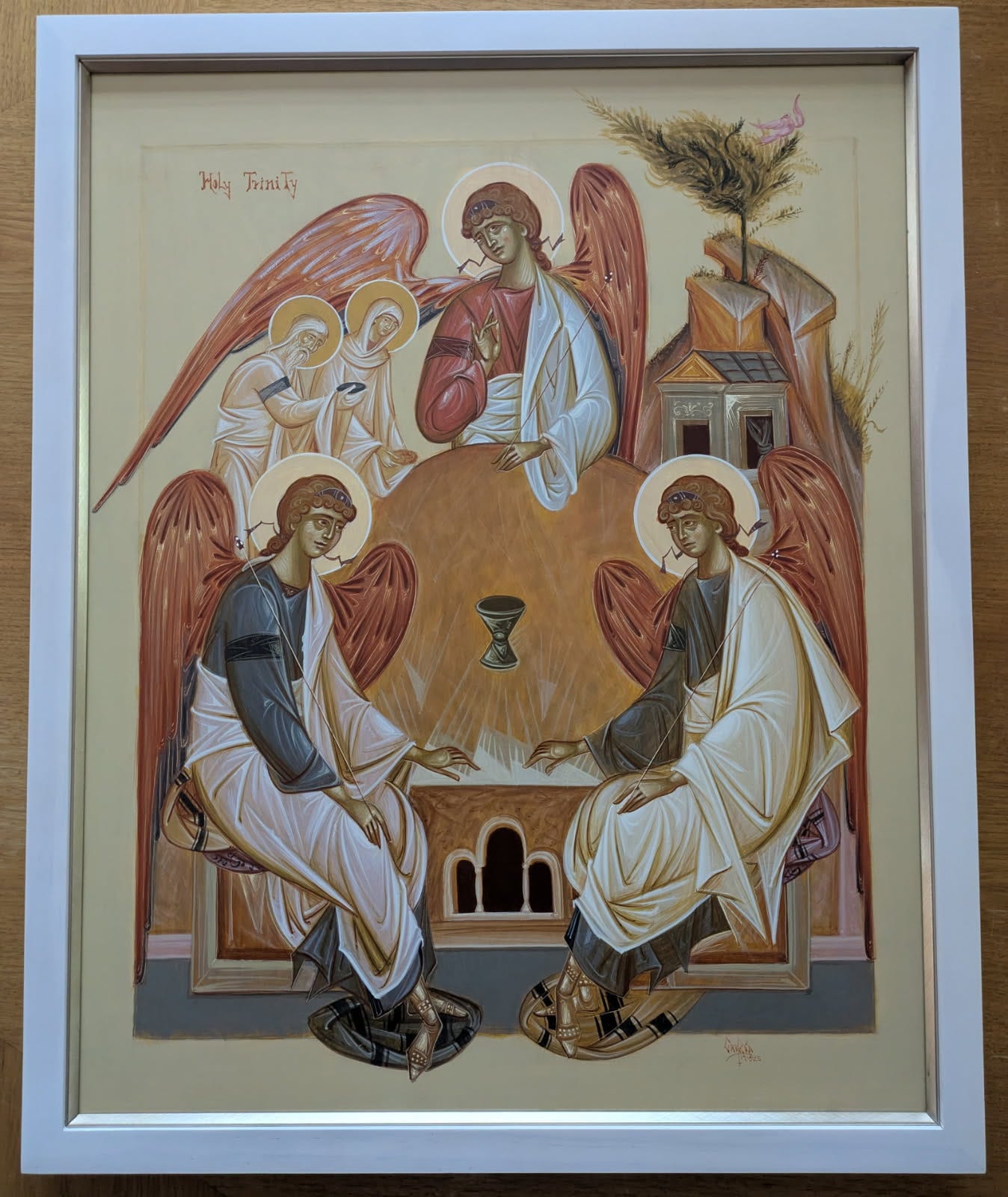
This image reminds us that we are called to be hospitable, but business and distraction don’t build unity. People long for a hearth, a home, a place of sharing. In this painting, the three figures of God the Father, God the Son, and God the Holy Spirit are gathered around a table, which symbolizes an altar. There’s a chalice on the altar, which is symbolic of the Eucharist.
When we think about this passage from scripture that we just heard, do we realize that we are called to partake of the divine life of the Trinity? And is that the one thing that is most important to us?
Jesus appreciates our work. He was a carpenter for 30. But he’s telling us that without taking that time to contemplate the divine in the world, the work that we do in the world won’t always be rooted in Christ.
St. Teresa reflected on how little we profit from the blessings God has granted us. This Scripture passage reminds us how rarely we sit at the feet of Christ to profit from the great blessing of partaking in the divine nature of Christ. Unpracticed at contemplation, our thoughts pursue their habitual paths, and quickly cease pondering the great mysteries of God’s infinite love.
“How can one be free,” St. Teresa of Avila said, “who is separated from the Most High? What harder or more miserable captivity is there than for the soul to have escaped from the hand of its Creator? Happy are those who find themselves laden with strong fetters and chains of the gifts of God’s mercy, so that they are unable to gain the power to set themselves free. O free will, thou art the slave of thine own freedom, unless thou be pierced through with fear and love for Him who created thee.”
A week and a half from now, we begin the liturgical season of Lent. Can we put aside five minutes every day for contemplative prayer? What about 15 minutes? Maybe 30 minutes?
Why is it easy to avoid the silence of contemplative prayer? It could be because, in the silence, it’s difficult to avoid thoughts about the self. St. Teresa counsels us that contemplative prayer must be a habit, a virtue, a discipline.

It’s not easy to contemplate God because the self gets in the way. We get distracted. And rather than worshiping and entering the divine life, our prayers become a list of demands to Christ: “Hey, do this. Tell someone else to do that.”
Jesus cares about our daily needs and worries, but we have forgotten the beauty of the contemplative prayer, of sitting being a partaker in this divine feast, and letting ourselves be changed by the reality that the divine has come into the world.
Ultimately, it’s the intimate encounter with God’s love that gives us the strength and the courage to keep going back out and pursuing our ideals, founding communities, and bringing others together, as St. Teresa of Avila did.
As we concluded the service, we sang together (in Spanish) these words of St. Teresa of Avila:
“Let nothing trouble you; let nothing frighten you. All things are passing; God never changes. Patience obtains all things. Whoever has God lacks nothing: God alone suffices.”
I concluded the service with these words from St. Teresa of Avila:
“May this self of mine die, and may Another, greater than myself and better for me than myself, live in me, so that I may serve Him.”

Margarita does great work in highlighting attractively and compellingly our shared Christian heritage to those who, in some cases, have become detached from their own traditions in their faith.
Thank You!