


It’s only days before my new semester of teaching at Princeton Theological Seminary starts. And with just a few days to go in August, we are $3,500 short of our goal of raising $15,000. Your donation today of any amount will help Scala launch its programs in Princeton this fall, continue building partnerships with artists and musicians, and provide resources to guide patrons of the arts—including you, a reader of our publications.
I’m incredibly grateful for new and recurring donors who have already contributed to our 10th anniversary campaign. Please take a moment and read what your support will make possible.
New monthly patrons of $100 more will receive a signed copy of my book, When Mary Calls: Surprising Encounters with the Mother of God.
A one-time gift of any amount will help us make the most of this great opportunity!
Forming Artists and Musicians
Partnering with The Vigil Project
At one of our many talks to parents of children in a classical school, one dad of five girls named Andrew Goldstein introduced himself to me and David. As a young man who studied classical music and worked in New York, he wanted to integrate his growing family life with his passion for music. He left the high-flying big city world of dwindling attendance at musically “innovative” but banal events to work in a Catholic parish. His heart longed for more, so he joined the Vigil Project, a group of young Catholic musicians dedicated to restoring great music in churches.
David Clayton, our Director of Strategic Partnerships and Artist-in-Residence, immediately wanted to partner with Andrew. Now, after many meetings, phone calls, and lots of hard work, Scala is proud to partner with Andrew and The Vigil Project. Andrew and David have co-authored a forthcoming book called Musica Domestica, to be published by Word on Fire Press in early 2027.
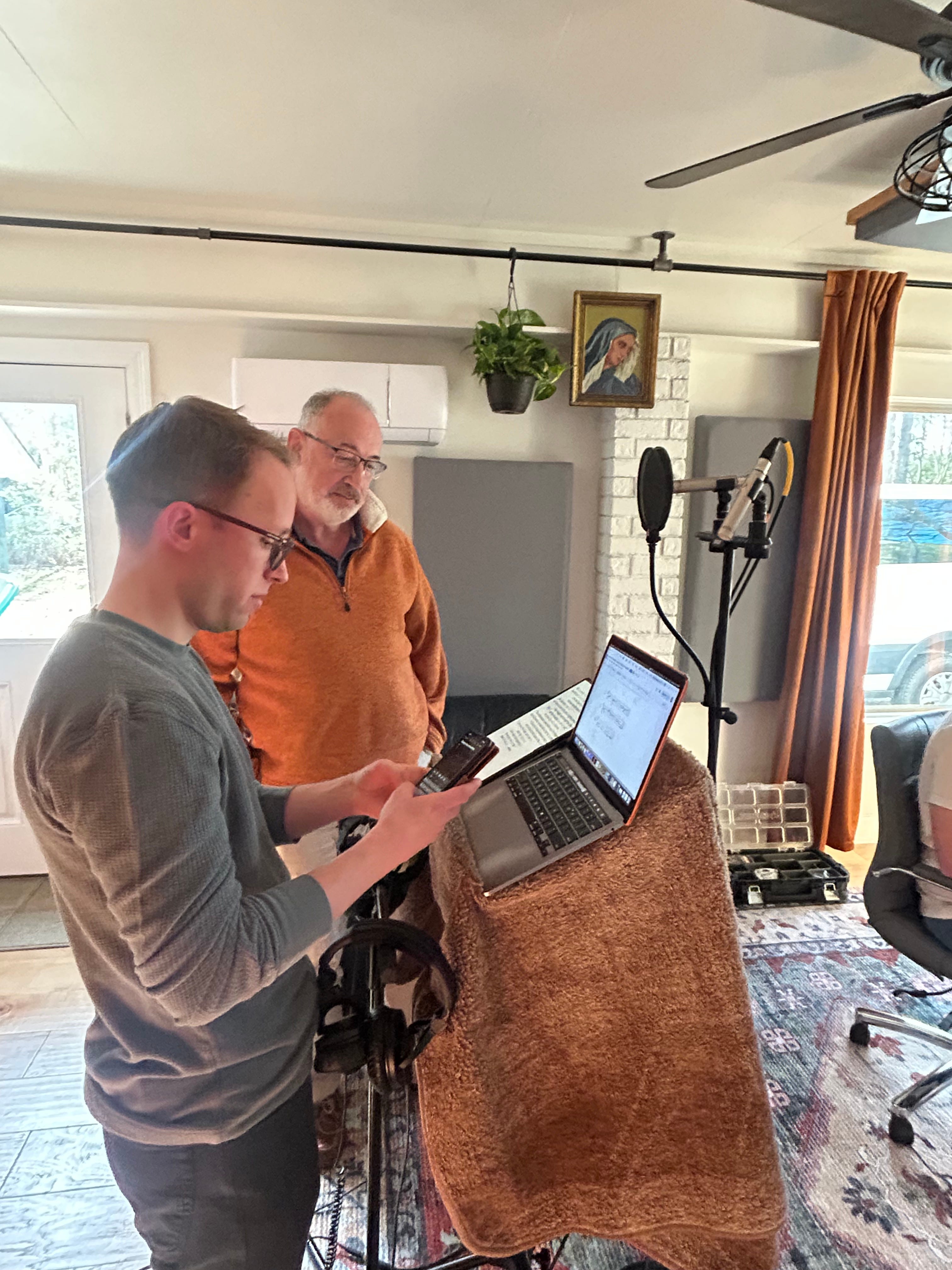
As Andrew shared with Scala’s board at our July meeting, “In the home, what we see a lot is that Catholics desire to pray with music, but they don’t necessarily know how. There isn’t really a catechesis in the world for how we pray with music.”
This two-volume book and the many training videos and events that are all motivated by questions we have thought hard about, as has Andrew:
“How do we restore a sense of music-making in the home? How do we inspire families to gather around the hearth again, turn the TV off, pick up an instrument, or simply sing together? And how does that, in the long term, overflow into the life of a parish?”
Andrew further explained that, “We help people understand that the parish isn’t the only place we have Catholic music. Many people bemoan what happens at their parish without realizing there’s something they can do in their own home that, in the long run, affects the parish too. Our mission includes what happens in the choir loft, but extends much further than that. We see Catholic music as a holistic problem and a holistic solution. Music extends into the home, into our time in the car, into our time of worship; it impregnates the whole of our integrated being.”
But, one attendee at the board meeting asked, what about people who don’t know how to sing, who have no pitch? Andrew’s thoughtful reply was that for starters, everyone can listen to beautiful music in the home. Making a playlist for the home and the car is one of Andrew’s practical ideas I’ve implemented in my life. Andrew described his ongoing efforts to find leaders in various regions to teach people how to sing using the music in Musica Domestica. You can see and hear more about this incredible book on its website. And you can hear Andrew’s vision for this book on The Vigil Project’s YouTube channel, which has over 50,000 subscribers!
Artists at Stabat Mater Singing the Psalms
Dominic Keim, a young art student at the Stabat Mater Atelier in Tyler, TX, reinforced the idea that a leader with some vocal training can quickly get a group to sing. As a high school student pondering his future, Dominic heard about the wonderful opportunity to study under Robert Puschautz at Stabat Mater and signed up for a rigorous 4-year program.
Dominic beamed the first time David and I walked through the doors of Atelier for David to give guest lectures on cultural and liturgical aspects of artistic formation. An artists’ toolkit, David emphasizes, includes the skills of making art, but to make art that inspires others to love God, one must practice the faith daily.
One particular practice David encourages young creatives of all kinds to take up is chanting the psalms. As Dominic told our board and guests, “Music lifts my soul to God, especially when doing it as a group or as a family. I’m not necessarily a musician, but my family sang prayers in the home, including the psalms.”Not all the other art students were as familiar with chanting the psalms as Dominic, so he offered to lead them, following David’s approach that will soon be published in Musica Domestica.
“A good number of the students were a bit skeptical at first, or unwilling to have their voices heard, but as time went on we became more comfortable, and it really became a very meaningful part of the day. It's a wonderful way to start our work day, singing in prayer as a group.”
Whereas too many art schools intentionally pull people away from their faith, Dominic reflected how, “Now that singing the psalms is part of our routine, I feel like I can grow in my faith as well. Everyone at the studio has grown to appreciate how it enriches our experience as art students.”
Way of Beauty Fellowship and Course in Princeton
In the coming months, I’ll co-lead a local Way of Beauty Fellowship in Princeton on Tuesday mornings. If you are local and want to join, let us know. Way of Beauty fellowships are beginning in other areas too, so reach out to find out more. Here is David describing the Way of Beauty process of spiritual formation.
I’m excited that I’ll also teach a 1-credit class at the Princeton Theological Seminary to train future leaders of Way of Beauty fellowship groups. Will there be skepticism at singing in a group? Hesitation? Some inconsistencies? Most likely—but as Dominic’s witness shows, it only takes one or two people to overcome those hurdles and get everyone once again making music and praying together, singing the Bible.
My other two classes, each for 3-credits, will use art and music to introduce students to how a Christian education and a classical education are meant to complement each other. My course “Teaching as a Christian Vocation” includes readings about Christian approaches to education from classical times and modern voices responding to progressive and Marxist approaches to education that elevate the social at the expense of the personal. For the fourth year in a row, we will visit an after-school program that is part of Nyansa Classical Community, which aims to bring classical education to minority and low-income students, teaching and learning alongside them with great texts, art and music.
My course on Ecumenical Devotion to Mary will include immersion in the Princeton University Art Gallery, both objects in the main galleries and many more objects called out of storage just for this class. The art will complement our reading of Scripture, early church reflections on Mary’s place in Christian doctrine and devotional life, and open students up to the symbolic and allegorical readings of our pilgrimage of faith.
Your Support Transforms Hearts and Minds
I’m just days away from a rigorous teaching schedule, and your support now is crucial.
Every gift this month of August, including your first month as a monthly patron, is matched dollar for dollar, up to $15,000. Thanks to all of you have already given. If you haven’t yet given, you still have time!
New monthly patrons of $100 more will receive a signed copy of my book, When Mary Calls: Surprising Encounters with the Mother of God.
A one-time gift of any amount will help us make the most of this great opportunity!
With gratitude for your readership, friendship, support and prayers,
Margarita Mooney Clayton,