


The rapid adoption of AI in many sectors of work study and life is opening up an incredible opportunity for educators to guide students towards an understanding of reason as openness to mystery. This semester, I have redesigned my classes enhance engagement, creativity and interaction. I’m delighted to report that these efforts have paid off, for me and for students.
For too many people, reason has become equated with what is sometimes thought of as techne—making things in the world. Powerful machines that use a lot of energy and run hundreds, if not millions of algorithms (in other words, machine learning or AI) are presently producing new information.
But the purpose of education is about using the fullness of our reason—including an openness to mystery and the sacred—to direct our skills and our technical knowledge towards our greatest end: love of others and love of God.
One student wrote to me recently, “I came to graduate school extremely interested in how to facilitate a religious education (without indoctrination) that fosters inquiry, wonder, imagination, discourse, and an appreciation of the process and mystery of seeking God. So, this class has been a dream come true! I appreciate your perspective on education as a whole as well as (what seems) your natural inclination towards beauty, creativity, and mystery.”
The Integration of Living and Knowing
Furthermore, as I’m seeing more than ever, students need to verify for themselves, in their own lives, what is good and bad about all the information they can now consume. As I wrote in Public Discourse in 2019, before the age of AI, about Luigi Giussani’s educational approach,
“Because humans are made to desire the truth, Giussani explains, we must exercise our reason to examine the totality of human experience… Experience matters for Giussani insofar as students must seek to know the truth for themselves, verifying in their own lives what authority and tradition teach. Without this personal verification, one can’t reach certainty about knowledge. Examining the totality of one’s experience is thus crucial for assenting to the truth….When the knowledge produced by the scientific method becomes divorced from truths about the final ends of the human person, students have no tradition from which to judge the proper use of human discoveries and inventions. Morality and ethics become divorced from reason, and are therefore seen as subjective, arbitrary, and imposed.”
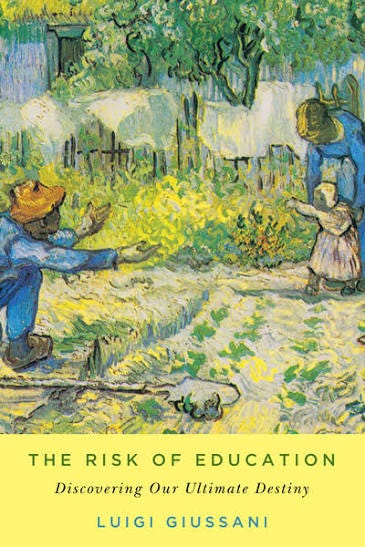
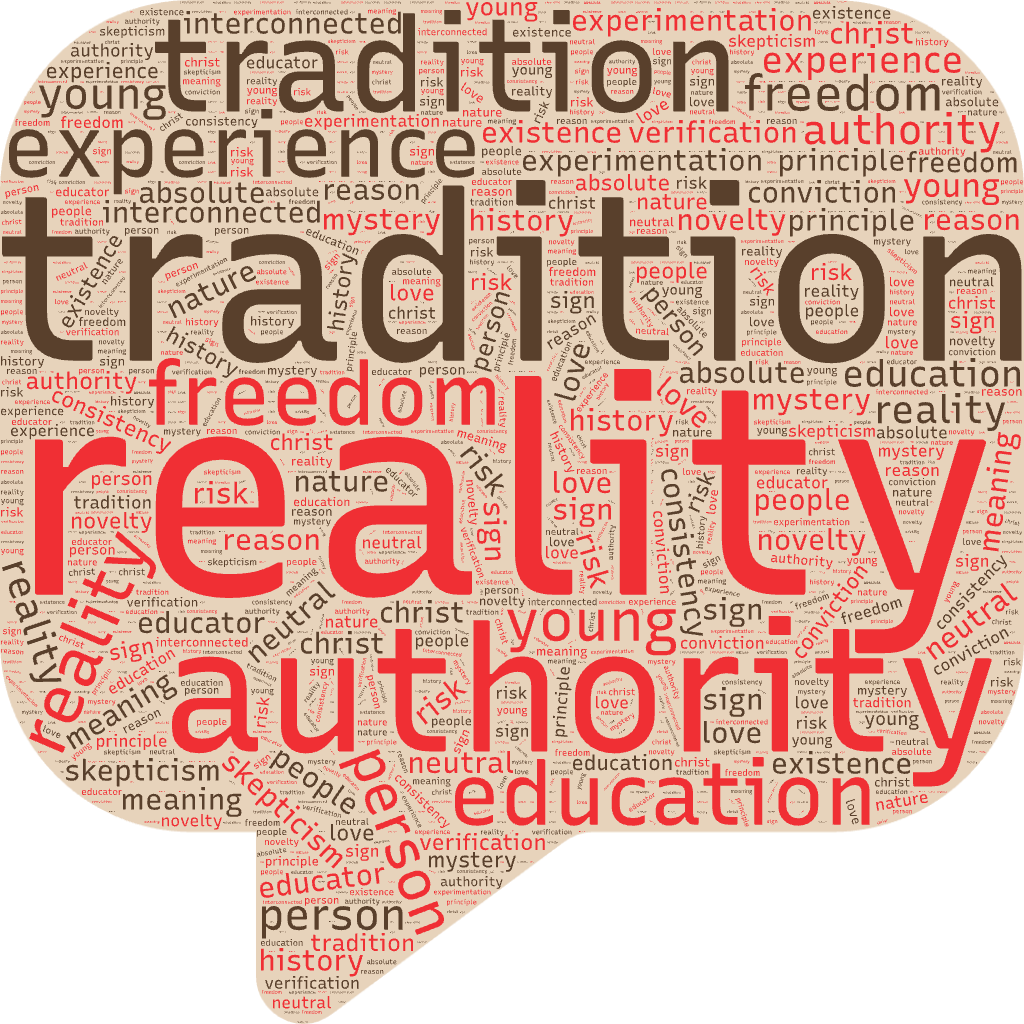
Machines are not capable of reason, as I am using that word, following Giussani and a long tradition of reason meaning not merely analyzing something, but knowing meaning, essences, and pondering how what we do know opens up new questions, new horizons. That’s what’s expressed in this word cloud my students made in class based on ideas from Luigi Giussani’s book The Risk of Education.
Also in 2019, I reflected in Scientific American about a trip to Italy that aimed to integrate engineering and humanities. In that essay, I wrote:
“Without educating all forms of knowledge toward mutual coherence, without standing in a tradition of thinking and being, our varied emotions, thoughts, expressions and even the things we create in a laboratory don’t add up to anything more than noise. Fleeting sensory pleasures or tools that badly fit the needs of humans don’t lead to human flourishing.”
Engineers, mathematicians and scientists need the humanities more than ever. Why? As I wrote seven years ago in that same piece, “Education in all fields of knowledge—including science and engineering—should be understood as part of educating the universal human longing for the infinite… Integrating the study of engineering and beauty will not only help students be more creative and take risks; it will help them resist the reduction of the human person to merely an object buffered from the transcendent.”
Machine learning might reach conclusions based on iterative calculations at great speed. But then what do we do with that information? There’s no reason, no way to direct information, apart from love and wisdom from lived human experience.
Machines can’t have human experiences. Machines do not have bodies. Machines do not have friends. They are not capable of love or wisdom. Machines cannot have a soul. Machines certainly do not have an integrated body and soul into which God breathed his own life, making us in his image, making us for a fulfillment beyond what we make in this world.
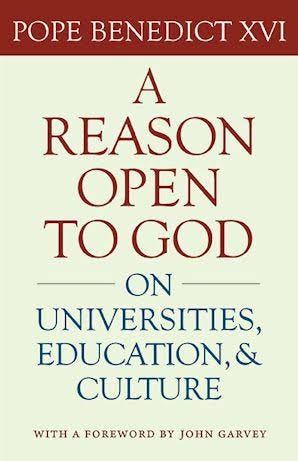
Let us not treat machines as if they were human. Let us not lower our desires, seeking some sort of short term return which is destined to be unsatisfactory to the human need for the fullness of truth, justice, goodness, beauty and communion with others and God. Here’s a book I recommended to a MIT graduate who studied physics before theology, Benedict XVI’s A Reason Open to God.
How I’m Teaching Without AI
In my classes, there is no artificial intelligence allowed, unless you count spell check other tools in libraries that help students find references. I do not allow AI for any kind of written expression.
Now into my fourth batch of handwritten essays, I’m relishing the uniqueness of everybody’s writing. I don’t mind that the sentences are not at the level of a published research paper. Perhaps they have slight misspellings or grammatical awkwardness. But I know each piece of writing that has been done by hand in class. I can truly hear each student’s voice and it’s exhilarating.
A friend who teaches at another Ivy League school told me that he explains to the students that if their employer wants them to know how to use artificial intelligence in order to be more productive that’s their business. But in his class he wants them to be more intelligent. And there’s no way to be more intelligent if you don’t struggle, make mistakes, learn from each other and the professor.
I tell students that AI can be seductive. You just ask it to do one little thing and it pulls you in, suggesting more and more ways it can do things for you. After a while you can’t separate your own thinking from the machine. My friend put it that by outlawing AI he’s taking away a near occasion of sin—the temptation to rely on the tool rather than learning for yourself.
In my class on Teaching as a Christian Vocation, we make charts, timelines and word clouds, using visual aids to our learning and exploring. Rather than have one student summarize a reading for class, I put students into small groups. Two people come with reading notes and quotes, present to the small group, and a third student, the scribe, writes down their thoughts to share with the full class. Students come with books or printed articles, filled with annotations, highlights and comments.
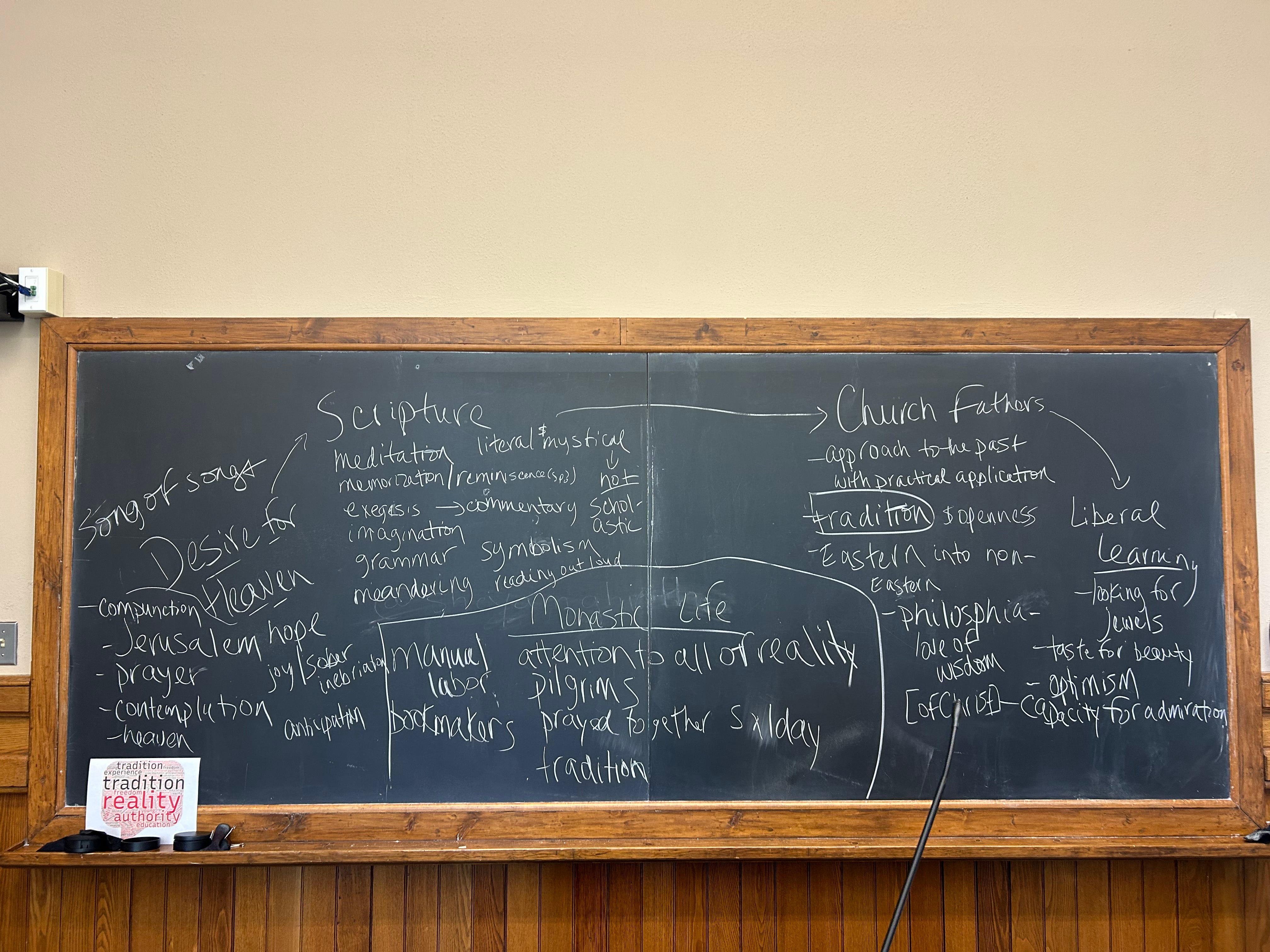
With my 12 pages of notes from Jean LeClerc’s Love of Learning and the Desire for God, I did not ask AI to produce a bullet pointed, numbered, series of tweets. We drew this chart in class, as prospective students visiting that day sat enthralled, excited, engaged in learning with us.
We will practice teaching through Nyansa Classical Community, where students will take turns teaching grade school children and observing their classmates’ in teaching, followed by a reflection to improve their teaching and do it again. Their final assignment is to create new lessons for Nyansa that will be used in their programs.
In my class on Ecumenical Devotion to Mary, we go to the Princeton University Art Museum, integrating art with scripture, as it was traditionally understood—a unity, not discrete objects. Students will teach the class using art and Scripture together. We recently visited Princeton’s Index of Christian Art, a now-digitized catalog of images, to look at images of Mary throughout history, across the world.
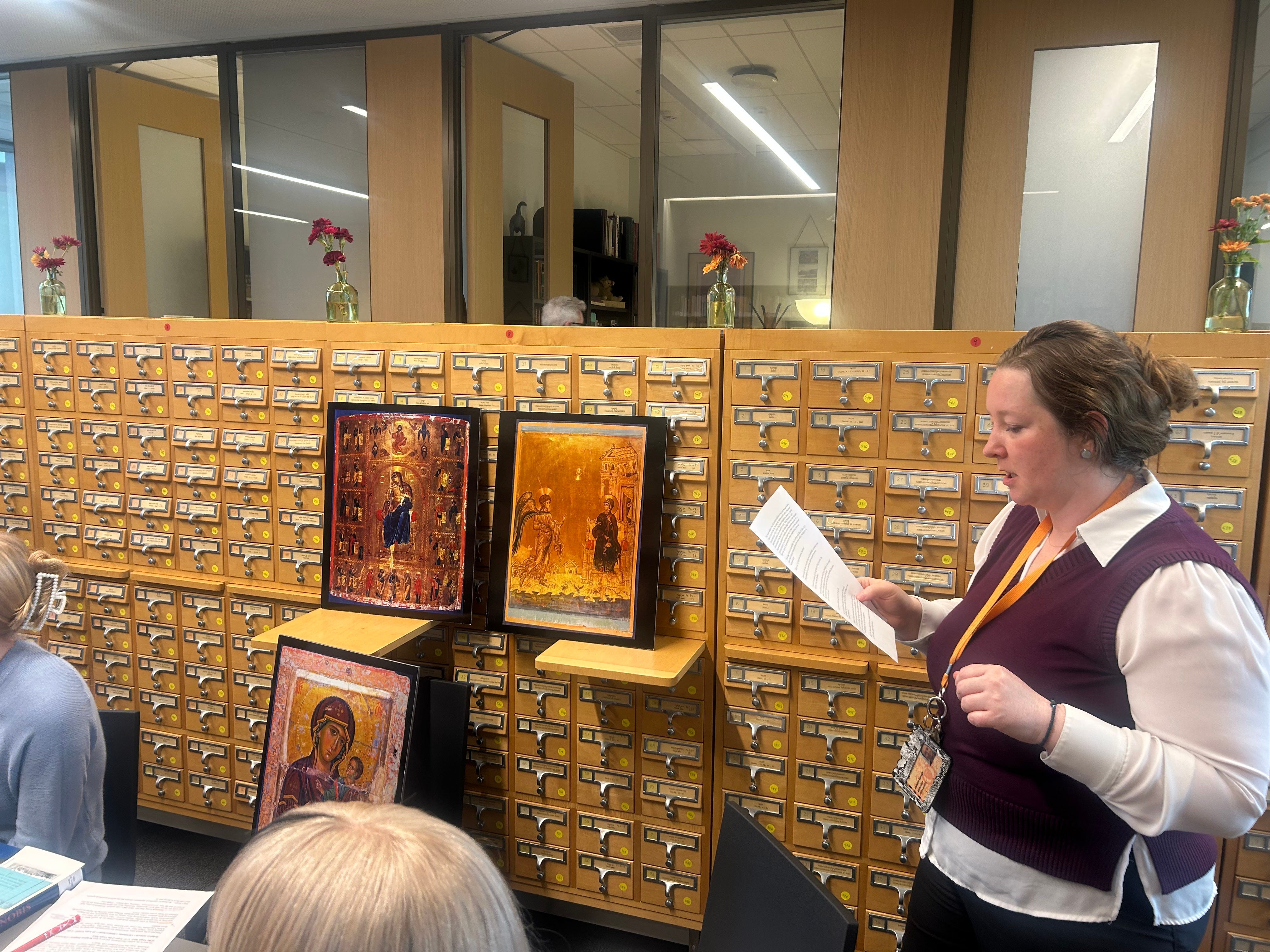
In my class on Psalms, Creativity and Vocational Discernment, we do handwritten exercises on gratitude, letting go of resentments, and our wildest dreams, then we share with others in class. We chant psalms, stimulating our creativity and openness to inspiration
Engage. Experience. Create. Integrate.
It’s a challenge for me as professor to make my classes an experience where they engage with others in class create and integrate what they’re learning and even learn how to teach others. But it is only by going on the adventure of engaging our full humanity in the use of our reason that students will ever be able to direct their own self growth in conversation with tradition, through habits of a disciplined mind, and a heart that remains open to seeing every new discovery as a sign of a bigger reality whose fullness we anticipate with joy and excitement but can never reduce to an algorithm on a computer.
Many people I know have tried and left AI, feeling disappointed. That’s why I think students are responding in very strong ways to Giussani’s point that we need to verify knowledge through our own experience. We begin with a tradition with what’s come from the past but we need to see, feel, and experience the practical applications of knowledge to our own lives. Otherwise we will dismiss discount retreat and be alone.
Only the Lover Sings
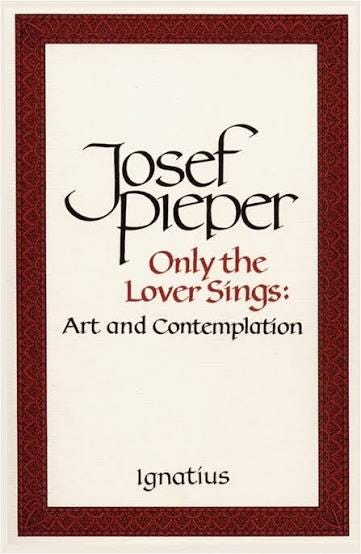
Yes, I’m still taking singing lessons, and I’ve even started piano. Now I can see why Josef Pieper entitled one of his short books “Only the Lover Sings.” He feared the reduction of human reason to “work”, mere productivity, not a human heart filled with desire overflowing in creativity and desire to serve.
I’ve taken steps to slow my breath, sing with my students, and learn from a master how to use my body—my voice and my hands—as an instrument of musical harmony. Singing and making music are mysterious experiences, a sign of the unity of all things beyond what our senses perceive.
Musica Domestica
Stay tuned, literally, as Scala plans events to help launch David' Clayton’s new book, Musica Domestica, co-authored with Andrew Goldstein of The Vigil Project. Not only are we planning a February 2027 premiere of the Scala anthem we have commissioned to composer Sir James MacMillan, we now also have commissioned work from composer Paul Jernberg as well!
As David Clayton wrote this week, “Scala Foundation is delighted to announce that it has commissioned Paul Jernberg to compose harmonized four-part settings of all the psalm tones used in my upcoming book Musica Domestica.”

“This will get families chanting authentic Gregorian chant immediately,” David predicts, and I can attest that he got my class singing Gregorian tones, which led to a standing ovation!
David has been on the road promoting the book already to hundreds of eager hearts. So be sure to follow him on The Way of Beauty.