


Every time I show people a picture of an icon made by Aidan Hart, like the one in my book When Mary Calls: Surprising Encounters with the Mother of God, they are mesmerized. I’m often asked: People still make art like that? Where can I get an image like that?
As of today, July 2, 2026, readers in the UK can see master iconographer Aidan Hart’s icon of the Nativity in my book When Mary Calls: Surprising Encounters with the Mother of God, that is now available for purchase in the UK from Blackwell’s, Waterstones, or Amazon UK.
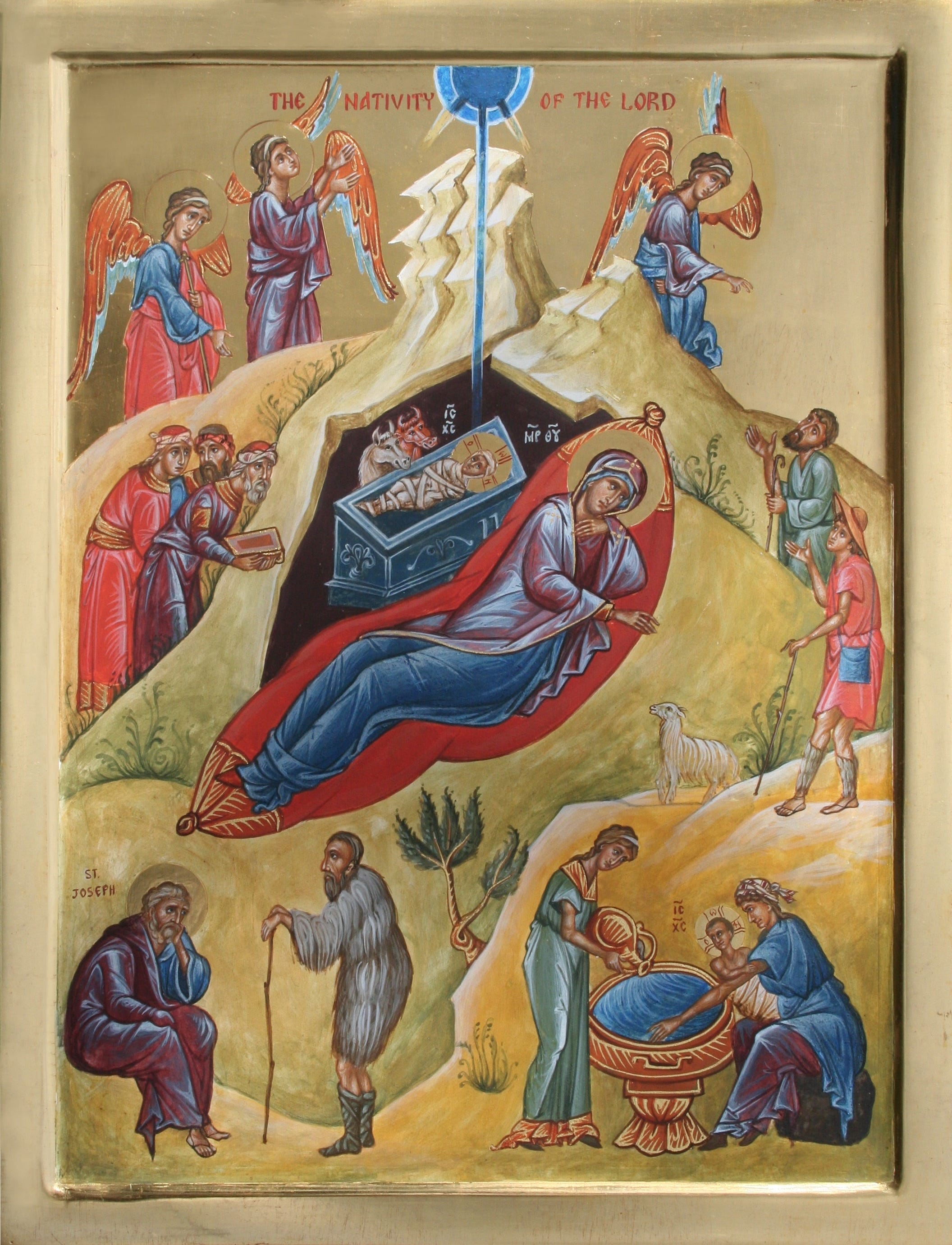
Mary as the Throne of God
Sacred art not only depicts a historical event but also demonstrates the union of two natures in Christ—the hypostasis. How does an artist like Aidan portray this event both as any other birth that took place in a particular time and place, and as recounted in Scripture, and as one that has a unique spiritual significance, unlike any other historical birth?
In this icon, Mary is presented both as a mother and as the Throne of God, or the Gatekeeper. For Aidan, referring to Mary as the throne of God is not merely an act of exalting her; it is an acknowledgment of God’s love for humankind. This imagery of Mary as the Throne of God traces back to Old Testament prefigurations. For example, the throne in Solomon’s temple was adorned with imagery suggesting divine presence. Mary fulfills and transcends these archetypes; she is not just a container or resting place for divine power, but a living, active throne that collaborates with divine purpose.
This icon of the Nativity by Aidan illustrates how allegorical titles of Mary help reveal the meaning of her presence at key moments in the New Testament and guide us to contemplate the great mystery of the birth of Christ. Aidan insists that he makes icons of the Nativity to help us experience this event again as if we were present at the birth of Christ. Icons of the Nativity invite us to reflect on the paradox of the Incarnation: the union of opposites—infinite becoming finite.
Thus, the mountain and the cave symbolize the Virgin Birth, representing both the divinity and humanity of Christ. The mountain symbolizes Mary, while the cave represents her womb. Our gaze rises to the heavens, yet we also encounter Christ in the cave. The old man in front of Joseph is the prophet Isaiah, reminding Joseph that the virgin birth of Christ fulfills a prophecy concerning his divinity.
Our eyes are naturally drawn to Mary, as she is the largest figure. However, it is not Mary herself who is the most important person in this icon; it is Christ. Mary’s position at the center of this image serves to remind us that her natural motherhood is essential to the union of the two natures—divine and human—in Christ.
The icon also visually represents Mary as the throne of God—she physically supports and presents Christ to the world, just as a throne elevates a ruler to be seen by their kingdom. Yet, unlike an ordinary throne, Mary is not passive; she actively contemplates the mystery before her. This paradox—that Mary is both nurturing Christ as his mother and worshiping him as her God—invites us to reflect on our own relationship with the divine.
The Gospel of Luke tells us that Mary wrapped the baby Jesus in swaddling clothes. Lest we wrap Jesus in shiny wrapping paper and forget that he came to die for our sins, this icon depicts the swaddling clothes as a linen shroud and places Christ in a cave in the rock that is a tomb as well as a place of birth. Thus, we contemplate the birth of Christ alongside a foreshadowing of his painful death and burial.
The throne imagery honors both Mary’s physical role in the Incarnation—her womb physically contained God—and her humble obedience, returning all praise for her back to God. Titles like Throne of God are meant to convey the profound intimacy between Christ and Mary, and, because of her humble obedience to bear God in the world, that a similar intimacy is possible between Christ and us.
When we elevate Mary to a position on a throne, we are not making her into a goddess: rather, we are acknowledging the great mystery that the infinite became finite in her womb. Just as Mary shared an intimate bond with her son while remaining herself fully human, we are transformed through grace to partake of the divine life of the Trinity.
Allegorical Readings of Scripture
I included Aidan’s conversion story and his work as iconographer in my book because many Christians—not only Protestants but also many Catholics like myself (before I met my husband David)—know very little about the tradition of allegorical readings of Scripture through images.
As a teenager growing up in New Zealand, Aidan discovered the Bible on his own, and then was mentored by a Baptist pastor and members of his congregation. He memorized large sections of Scripture. When Aidan learned of the Orthodox tradition of making icons to express the allegorical readings of Scripture, his love for the word of God deepened.
He became Greek Orthodox, and has made art for Protestant, Catholic, and Orthodox churches in at least 25 countries. My husband David once assisted Aidan paint frescoes in a private chapel belonging to then-Prince Charles of England.
At Scala’s 2023 conference at Princeton Theological Seminary, Aidan lectured on the topic of “Liturgical Art as Prophecy and Priesthood.” Recovering the iconographic tradition is about much more than art. Without a vision, the people perish, Aidan insisted, drawing on Proverbs 29.
During that same visit to Princeton, Aidan sat down in the video studio with me and Jonathan Pageau , an icon carver, writer, and podcaster whose work on symbolic meanings has reached countless people.
As the three of us discussed icons of the Transfiguration, I realized even more how sacred art helps restore in our hearts the sense that God’s grace is not merely about healing us from sin (as much as I need that!). Sacred art draws us into the mystery of God’s love, lifts us up, and allows us to experience God’s glory radiating through the material world into our inner being.
Mary, the Mother of God, knew very well that our sacred callings require discernment. In this conversation with Aidan, he discusses themes from his book Festal Icons, which looks at traditional ways the Annunciation to Mary by the Angel Gabriel has been depicted, highlighting her not as a passive vessel but as actively listening for God’s word and responding in obedience, with joy and hope, to the will of God.
Icons: Living or Dead?
Why do Catholics and Orthodox pray to dead people like saints? A Pentecostal student told me that a church historian who identifies as a Reformed Christian recently answered that question by telling her, “Because they don’t believe the people depicted are dead. The saints are alive in heaven.”
The misperceptions about icons are not new; what seems new to me is the keen insight of people like UK journalist Mary Harrington, who, in her review of my book, noted many reasons why icons of Mary are particularly speaking to reverts to Christianity like her and many, many others right now.
Harrington’s remarks inspired my husband David to write two articles on his Way of Beauty Substack about the connections between early church understandings of Mary’s active cooperation with God’s will and the debates about the veneration of images in the church, which are, in fact, deeply connected.

My instinct, confirmed by Harrington’s response to my book and by every single person to whom I’ve ever shown one of Aidan’s icons, is that beautiful sacred art will help people to know Mary as a living person, and increase their desire to thank God for such a beautiful spiritual mother whose love reaches us from heaven.
This Glory Can Be Yours
If you are new to icons specifically, or new to sacred art entirely, I suggest simply having one icon of Mary and Jesus in your home. Let your gaze rest on the image. You don’t have to ask for a miracle, nor speak any specific words, or any words at all. Treat Mary and Jesus pictured in your home as you would a picture of your family. They are your family.
Regardless of whether or not you already love icons or just want to take the first step, look at Aidan’s amazing website where you can find out how to study with him, read his articles, gaze at his work on the screen, purchase a print of his work, or even commission an icon for your church.
I particularly encourage my readers in the UK to order When Mary Calls today. If you already own my book, consider giving it to someone else as a gift.
You can be a patron of Aidan’s work through his Patreon program, where monthly donations from as little as 2.50 GBP a month will ensure you will never have a day devoid of sacred beauty.
More Coming Soon from the UK
I’ve recently arrived in the UK, where I’ll be recording interviews about the book with The Catholic Truth Society and The Spectator (UK). I’ve also had the chance to meet Mary Harrington personally, and to discuss CS Lewis and Mary with Rev. Dr. Michael Ward, the world’s leading scholar of Lewis, who is based in Oxford. I’m grateful to Blackfriars Hall at Oxford University, where I started the research for this book and for their commitment to integrating beauty, truth and virtue in their work and lives.
And I’m visiting Aidan’s studios again in Shropshire, and I’ll post some notes about the beauty I find there!