


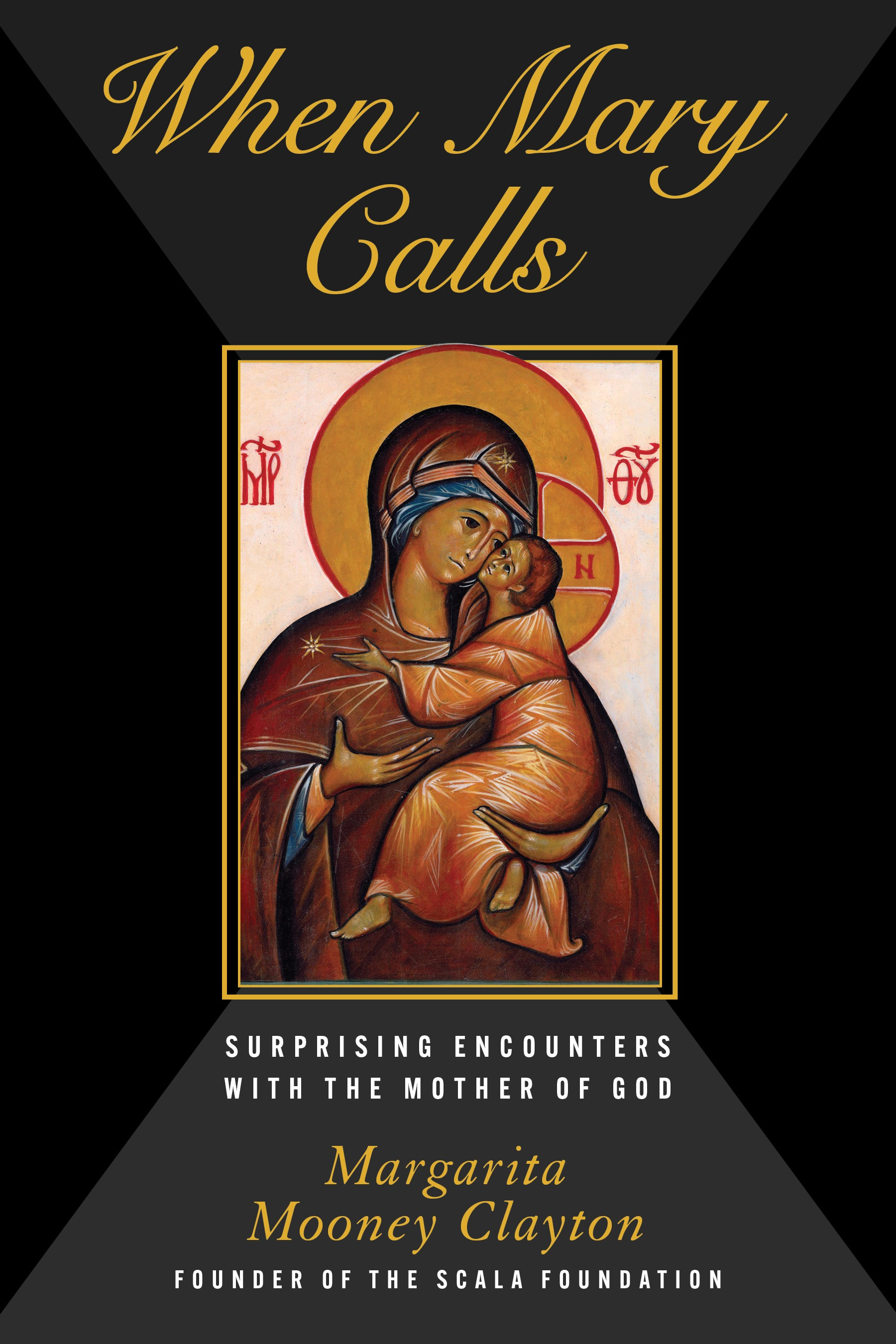
Have you ever pictured Mary at Pentecost? She was there, but is too often overlooked. Take a moment, if you haven’t already, to order my brand new book, When Mary Calls: Unexpected Encounters with the Mother of God, in which I hope to invite readers like you to ponder Mary across the New Testament, from the visit of the Angel Gabriel at the Annunciation to the coming of the Holy Spirit at Pentecost.
Knowing Mary better thus allows us to explore larger questions all Christians grapple with such as: how does God’s grace work? What did the Apostle Peter mean when he said all followers of Christ “may become participants of the divine nature” (2 Peter 1:4)?
Each chapter of my book presents people encountering Mary, herself a vessel of the Holy Spirit at the Incarnation, as, they, too, long to to have Pentecostal moments. Those moments where we feel upheld by God’s grace strengthen our faith that deification, or sanctification, becoming partakers in the divine nature, is a possibility for each and every person.
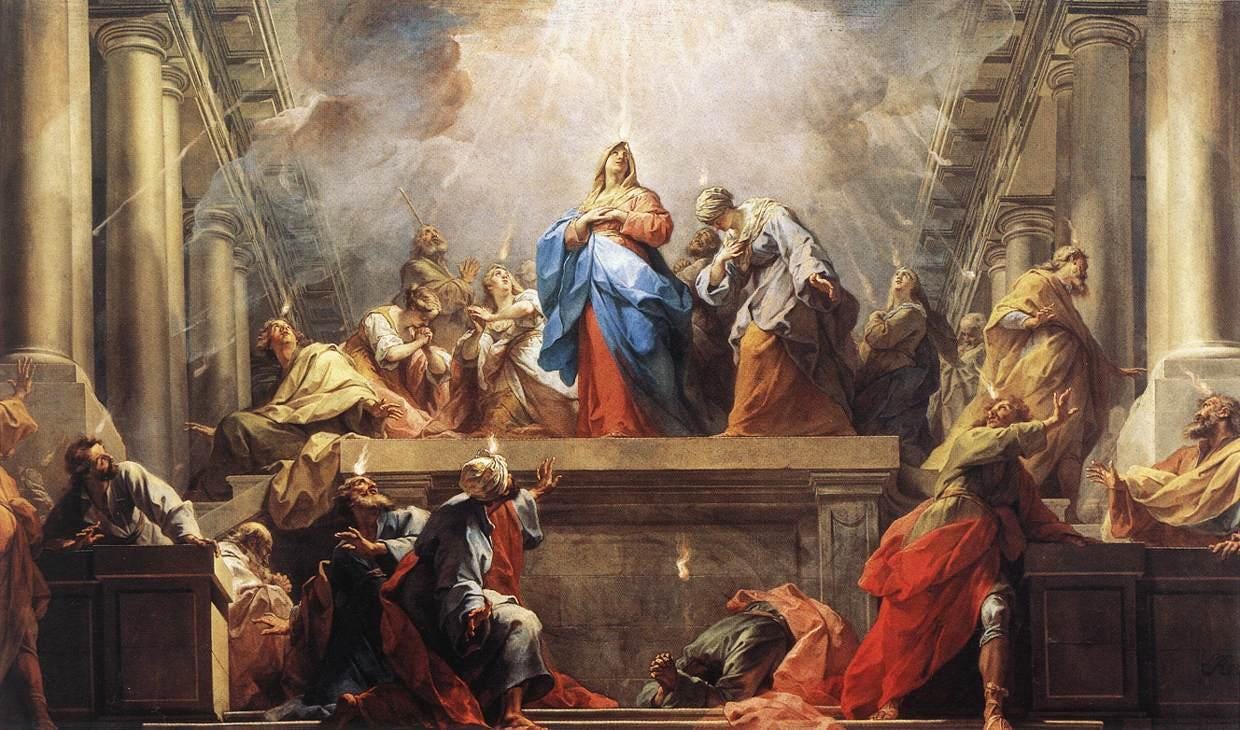
Acts 1:14 names Mary as being present in the upper room while the disciples awaited the coming of the Holy Spirit. Images such as this one by Jean Restout visually illustrate Mary’s central presence at the coming of the Holy Spirit upon the apostles.
A Student’s Reflections on Mary at Pentecost
The very first time I taught a course on Mary to my mostly Protestant students at Princeton Theological Seminary, a young man named Kyle Barton said he thought knowing more about Mary’s life of grace would help him understand in how the early church understood deification.
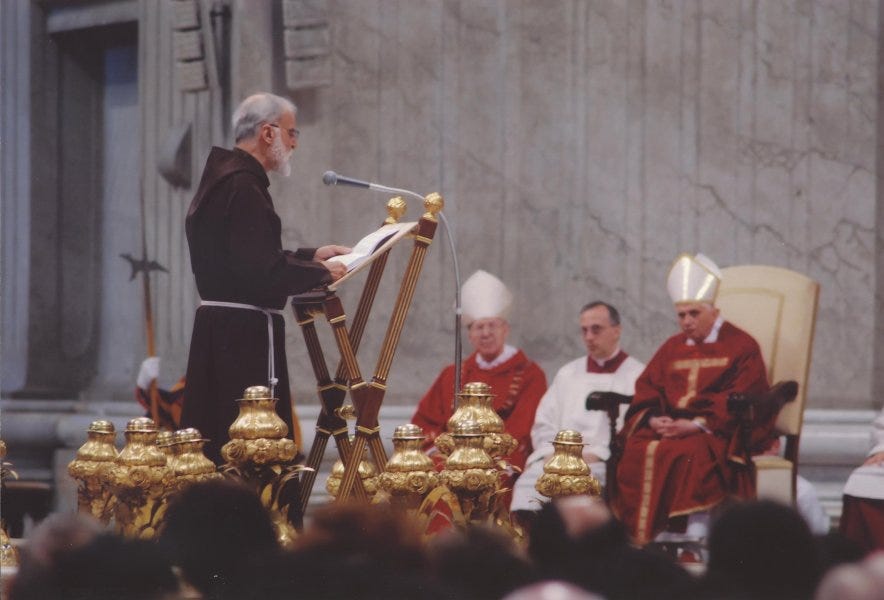
For one of his class assignments, Kyle studied Cardinal Rainero Cantalamessa’s Mary, Mirror of the Church. Born in Italy, and having studied theology in Fribourg, Switzerland, and classical literature in Milan, Italy, Cantalamessa served for 12 years as a member of the Catholic Commission for dialogue with the Pentecostal churches. He was appointed preacher to the Papal Household by Pope Saint John Paul II, a position he also held under Pope Benedict XVI and Pope Francis.
Cantalamessa: Mary is a Mirror of the Church
Kyle, who is now continuing his theological studies as a PhD student at Baylor University, wrote a fantastic introduction to Cantalamessa’s book, which I quote here:
“In Mary, Mirror of the Church Raniero Cardinal Cantalamessa presents a series of reflections on the scriptural witness to Mary as a path to practical holiness. As the title indicates, Cantalamessa views Mary as a mirror of the church. All Christians are to see an image of their own calling to faithful discipleship reflected in her experiences. Though her role in salvation history is unique—for no other human is elected to be Theotokos—her experiences, in principle, are not unrepeatable. She is a map that God gives us for our own pilgrimage to practical holiness, and if we know how to read her correctly, a clear path forward will open for the church.
While the New Testament mentions Mary only a few times, Cantalamessa believes these references are strategic and of great significance, containing clues to the crux of the Christian life. As Cantalamessa points out numerous times, only Mary was present at all three events that form the heart of the Christian mystery—the incarnation, the crucifixion, and Pentecost. Like a small glimmer of gold in a mine, these references, though scant, should signal to believers the riches available here if they just started digging. Contemplating Mary’s place in these mysteries elucidates the mysteries of our own pilgrimage of faith, for here a human vessel participates in the great events that comprise salvation—the union of divinity and humanity, the defeat of death and removal of sin, and the birth of the church through the reception of the Holy Spirit.
To be a Christian is to know these mysteries experientially, and thus to be a Christian is to follow in Mary’s footsteps no less than it is to follow in Abraham’s. Cantalamessa’s conviction is that God speaks to us through Mary’s life, and though the Scriptures do not present her as loquacious, she is in fact ‘pregnant with the Word,’ so that ‘the few words and verses referring to her in the Gospels are extraordinarily charged with meaning and resonance.’“
Reading Kyle’s full paper, linked to here with his gracious permission, will certainly delight you as much as it did me!

Cantalamessa writes and speaks about Mary, as do I, with the hope that, as she did at Pentecost, she will serve as a source of unity, helping Catholics and Protestants encounter the Scriptures anew.
Mary and the Gospel of Grace
The title of my book, When Mary Calls, attempts to capture the reality I encountered: many people from a variety of Christian backgrounds, or no particular religious background, are experiencing Mary’s presence in their lives, calling them to a life of holiness, of seeking to walk in God’s grace.
I wrote my book for seekers as well as those who already know Mary well, or only known a little. I’m inspired to do what Cantalamessa describes as presenting “the Christian life through preaching the gospel of grace…in a kerygmatic way [a passionate proclamation of the Gospel of our salvation[, certain that it has an intrinsic power.” I do not discard dogmas as somehow irrelevant, but I focus on the transformative life experiences which give those dogmas meaning.
As Cantalamessa writes, “When Scripture is the basis, the starting point is God’s Word, and in expounding its meaning, the dogma is reached as the true interpretation given by the Church. This is the way truth came down to us.”
Mary’s presence at Pentecost reminds us that we are not meant to journey towards God alone, but with the church. Cantalamessa writes, “Mary is a mirror of the Church in two ways: to reflect the light she herself receives as a mirror does with the light of the sun. And because she is such that the Church can and must mirror herself in Mary to make herself beautiful for her heavenly spouse.”
Yes, Mary was the First Pentecostal
After going through each chapter of the book, Kyle reaches a profound conclusion that can be drawn from meditating upon Mary’s presence at Pentecost. As he wrote in his essay for my class “Ecumencial Devotion to Mary”,
“Chapter 8 brings us directly to Pentecost, where Cantalamessa christens Mary ‘the first pentecostal’ in the church. A striking parallel is sketched between Mary’s experience in Luke 1 and the church’s experience in Acts 1. In both instances, the Spirit comes upon individuals who then proclaim the great things that God has done. Mary becomes a type of the church as ‘a living organism, irrigated and animated by the Holy Spirit’ through both sacraments and charisms. Most interesting here is how Mary becomes an example of ‘the free and unpredictable action of God’s Spirit,’ who works ‘outside the instituted channels’ of the church’s hierarchical structure. Mary’s experience teaches us to look to a God who ‘intervenes explosively… to renew a tradition and a cult that have become simple routine and formalism.’
Chapter 9 is on the Johannine Pentecost—’he bowed is head and give up his Spirit.’ While Luke emphasizes the Spirit’s power in the church’s mission, John emphasizes the Spirit’s presence in the church’s life. Mary teaches us that no matter how much God has used us in the past, we are always in need of ‘new and successive effusions of the Holy Spirit’ and that many times Pentecost ‘takes place beneath the cross.’
Cantalamessa has given us a rich meditation on Mary as an example of the path of discipleship. There is much here that Protestants can appreciate. Although Cantalamessa does not skirt the Marian dogmas, he goes out of his way to be conciliatory and to be sensitive to his Protestant siblings’ consternations and grievances. When he unavoidably must present Mary’s premier role and titles per Catholic teaching, he reasons at length to make them intelligible, admits that they have been sometimes taken to wrong extremes, and even a few times does not insist that all have to follow this path. After explaining how believers, like John, are to take Mary into their lives—one of the more devotionally radical teachings of the book—he then concedes that ‘this kind of life with Mary is not the only and necessary way to be imposed on everyone.’ He longs that Mary would become a source of unity in the church, not division.”
Part of the assignment for class was to imagine how a book about Mary would reach Protestants.
Kyle wrote: “Would this approach appeal to Protestants? I think so. It is a serious, engaging, and heartfelt plea to learn from Mary to whatever extent the Spirit calls one. There are resources in these pages that could spawn numerous Protestant Bible studies and sermons. Protestants do well to listen attentively and follow where they can.
Cantalamessa showcases the value of a devotional approach ‘from below,’ sourced in Scripture. I was truly surprised by the mileage he got out of this approach, especially when put into conversation with the whole canon of Scripture powered by a typologically rich hermeneutic. This is a book I will be returning to and recommending to my fellow Protestants who are looking to reflect more deeply on the lessons that Mary’s life can teach us. And for those Protestants who are not yet able to call Mary Mother, maybe they can start with Mirror.”
Cantalamessa’s book presents a challenge, or maybe better put, an adventure, that Kyle was willing to take up. After we consider something in Mary’s life, we must ask ourselves, what does this mean for us? We must not just be hearers of the Word, but doers, as Mary herself was.
Our Response to the Holy Spirit
As Cantalamessa puts it: “Mary teaches us to say yes to God with freedom, joy, and passion.” Mary calls us towards God, and, if we allow her, she will teach us to be good disciples, as she certainly did in the upper room at Pentecost and for the early Christian church.
Mary’s quiet presence at Pentecost, and her often silent presence at other places in Scripture, including the Nativity and the Cross, is pregnant with meaning. Perhaps, with Mary at our side, we can look anew at the Scriptures, opening ourselves to the power of the Holy Spirit to transform us from within, moving from silent prayer to willing obedience to God’s calls.